
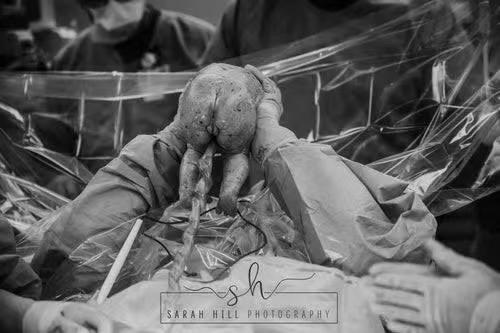
A black-and-white documentary moment of midwife Emily Dial personally delivering her daughter. Source: HuffPost UK
1. The Breakthrough: A “Maternal-Assisted C-Section” on the Operating Table
In contemporary documentary photography, birth photography has long hovered between intimate family record and clinical archive. Sarah Hill, a photographer from Kentucky, transforms the cold, restricted operating room into a visual stage that celebrates maternal power and female autonomy, driven by her extraordinary ability to capture authentic humanity.
In March 2018, inside an operating room at Frankfort Regional Medical Center in Kentucky, veteran midwife Emily Dial was about to welcome her daughter via C-section. Unlike the vast majority of mothers who can only lie passively behind the surgical drape, Emily and her medical team, after careful planning, decided to perform a rare “Maternal-Assisted C-Section.”
As Emily’s close friend, Sarah Hill was granted permission to bring her camera into the sterile operating room. Once the surgeon completed the abdominal incision, Emily — already fully scrubbed in and wearing double sterile gloves — reached down with both hands, cradled the baby’s head and torso, and guided the new life into the world inch by inch. From a tightly limited vantage point just outside the sterile field, Sarah Hill worked at low angles and mid-range distances to seize the key moments: the baby’s bloodied body crossing the transparent sterile drape, the mother lifting her newborn with surgical-gloved hands, and the tears of joy upon confirming the baby’s gender — three frames unfolding into a continuous, dramatically charged narrative.
Once published, the work was picked up by major international outlets including People, The Independent, BBC, and HuffPost, sparking a long-tail wave of global coverage.
2. The Documentary Tension: Clinical Coldness Meets Primal Maternity
What elevates this body of work beyond a viral internet hit into an enduring documentary classic is the layered visual and emotional tension woven through every frame:
1. Striking Environmental Contrast
Plastic sterile drapes, IV lines, surgical gloves, and reflective surgical cloths form a highly functional clinical setting; yet at the heart of each frame lies the newborn’s fragile, warm body and the mother’s resolute gaze as she overcomes her fear. This collision of “cold industrial aesthetic” with “fierce primal life” gives the images an extraordinary visual force.
2. The Purifying Power of Black-and-White
Sarah Hill relied heavily on high-contrast black-and-white processing for the core images. Stripping away the harsh reds of blood and the visual chaos of the operating room lights, the viewer’s attention is funneled entirely toward the hands at work, the light sculpting the contours of muscle, and the subtle micro-expressions revealed beneath the mother’s surgical mask.
3. An Unrepeatable Backstory
Years earlier, Emily had lost her first child Grayson to a congenital diaphragmatic hernia. When her daughter Emma Kaye was born, the camera captured more than a successful medical procedure — it documented a mother’s redemption, a ritual of reclaiming control over life after profound loss.
3. Reframing the Narrative: From “Patient” to “Sovereign Subject”
Before Sarah Hill’s lens, public perception of birth photography was largely confined to two poles: on one end, the soft-focus, heavily retouched postpartum portraits bathed in warm light; on the other, the clinical, cold imagery of medical documentation. Sarah Hill’s documentary intervention introduced a fundamentally new perspective:
- A de-objectified feminine gaze: In traditional C-section documentation, the mother is typically portrayed as a “patient” — passive, anesthetized, and controlled. In Sarah’s frame, Emily is the undisputed protagonist and active agent. The lens fully captures her command over motherhood even amid physical agony and surgical intervention.
- Documentary discipline under extreme constraints: The medical environment demands that the photographer anticipate lighting and movement while strictly maintaining the sterile field and never obstructing the medical team. Drawing on her deep familiarity with the subject and exceptional in-the-moment reflexes, Sarah Hill achieved precise balance of composition and exposure within a few irreversible seconds.
This body of work not only cemented Sarah Hill Photography as a distinctive voice in the Western documentary photography scene, but also proved that authentic documentary work needs no contrived staging or beautification — when you stand on the edge of genuine humanity, images carry a lasting power that transcends culture and borders.
4. Four Career Stages: From Craftsperson to Aesthetic Brand Owner
Sarah Hill’s career trajectory (under her brand Sarah-Beth Photography) represents a classic paradigm of how contemporary Western independent photographers evolve from “technical craftsperson” to “aesthetic commercial brand.” It can be clearly divided into four stages:
Stage 1: Style Establishment and the Preset Boom
Based in Indiana, she focused on documentary family, newborn, and maternity portraiture (under the brand Sarah-Beth Photography). While most of her peers were still working with traditional studio lighting and rigid posing, she was among the first to establish a clear visual signature: “Emotive, Moody & Warm” — driven by natural light and gently underexposed tones.
This earth-toned palette, with its golden warm shadows and analog film feel, generated enormous demand for emulation across the industry. She capitalized on this by developing Lightroom / ACR presets and Photoshop Actions. Global sales propelled her swiftly from a “regional booking photographer” to a household name within the North American photography community.
Stage 2: Deepening the Craft — Photography Mentor and Workshops
With presets alone quickly facing commoditization, Sarah Hill pivoted into the higher-barrier space of photography education and masterclasses. Her core teaching framework includes:
- Prompts over Posing: A systematic method for capturing authentic, unstaged interactions through games and situational prompts.
- Mastery of natural light in extreme conditions: A workflow for locating and shaping natural light sources in overcast weather, low-light interiors, and visually chaotic environments.
She was invited to speak at major photography platforms such as Click & Co and The Reset Conference, while also selling proprietary photography guides and one-on-one mentoring services — steadily amplifying her industry influence.
Stage 3: Aesthetic Spillover — The “Client Closet” and Styling Consultancy
Over years of shooting, she recognized that no amount of perfect lighting and color grading could save a frame if the client wore the wrong outfit — the visual story would simply collapse. In response, she began sourcing earth tones, linen textures, bohemian and vintage dresses on a large scale, building a complete Client Closet to control the color palette of her images from the very source.
Her role as a photographer quietly evolved into that of a visual styling consultant. On Pinterest and Instagram, she shared not just finished images, but the underlying logic of styling and aesthetic philosophy — accumulating a large lifestyle audience well beyond the photography community.
Stage 4: The Commercial Loop — Launching Her Own Apparel Brand
Her sensitivity to garment cut, fabric texture, and vintage palettes was eventually translated directly into physical products. She officially launched Sarah Hill Co, a brand focused on women’s apparel, dresses, hats, and lifestyle goods.
At this point, photography shifted from being her “primary revenue driver” to her “highest-dimensional content engine” — she now uses world-class family and portrait photography techniques to produce lookbooks and daily content for her own clothing brand.
The Final Loop: Photography Technique → Preset Tools → Skill Education → Aesthetic Productization. She completed the transformation from a shutter-pressing freelancer to a brand owner controlling her own aesthetic IP and supply chain.
5. Core Methodology: “Prompting” Over “Posing”
“Posing” manages the geometry of the body; “prompting” manages the flow of the subject’s attention and emotion. By giving small action-based tasks, psychological triggers, or physical touch points, the subject’s attention is redirected away from the cold lens and toward each other — allowing micro-expressions to emerge that simply cannot be faked.
The Core Formula: Replace “Nouns and Posture” with “Verbs and Situations”
Traditional posing often relies on result-oriented instructions (“tilt your head slightly to the left,” “smile at each other”), which immediately triggers the subject’s self-consciousness and camera awareness, leading to stiff smiles and mechanical body language.
Emotion follows a simple formula: “Physical Action + Psychological Suggestion = Authentic Response.” The photographer never dictates facial expression — only the physical interaction and situational task. The real magic is captured in the unexpected laughter, the bashfulness, the spontaneous embraces that emerge along the way.
Field Guide: Four High-Frequency Scenarios
1. Icebreakers and Laughter (Breaking Through Awkwardness and Stiffness)
- Prompt: “Walk toward me hand in hand, and every three steps, give each other a little hip bump — let’s see who knocks the other off rhythm first.” (Hip Bump)
- Capture moment: Don’t fire the shutter while they’re earnestly counting steps. Wait for the moment one of them loses balance, catches each other’s eyes, bursts out laughing, or instinctively grabs the other — then fire off a burst over that 1–2 second window.
- Advanced variation: “Walk toward me like the two of you have had just a little too much red wine — arms around each other, weaving and wobbling.”
2. Intimacy and Micro-Expressions (Creating Deep Connection)
- Prompt: “Lean in close to their ear and, in your most tender / husky voice, whisper what you had for breakfast this morning — or share one word that absolutely nobody else here is allowed to hear.”
- Key principle: The photographer doesn’t actually need the “secret” itself — they need the natural physical closeness, the cheek-to-cheek contact, and the inevitable burst of suppressed laughter, shy lip-bite, or gentle shove that follows.
3. Family and Children (Managing Chaos and Unpredictability)
- Prompt A: “Mom and Dad, you are two thick slices of bread. The kid is the peanut butter in the middle — on my count, the bread squeezes tight, and the peanut butter tries to escape!” (The Sandwich)
- Prompt B: “Shhh, all the little ones listen up — sneak around behind Dad, and on the count of three, pounce and grab his legs. Let’s see if we can shake the big tree down.” (Surprise Hug)
- Key principle: Never verbally “discipline” a child with “stand still” or “look at the camera.” Instead, give them a game with stakes or a touch of mischief. It’s in the chaos — the tangled hugs, the unrestrained laughter — that the most vivid life force emerges.
4. Emotional Grounding (Stillness and the Breath)
- Prompt: “Close your eyes, press your foreheads together, take a deep breath, and smell the scent of each other’s hair. Feel the rhythm of the other’s breath.”
- Capture moment: Best used mid-session or near Golden Hour, when the light is softest. With eyes closed, subjects drop their visual defenses — the faint flutter of lashes, the softening or subtle upturn of relaxed lips, all become immediately visible.
Invisible Corrections: Redirecting Through Action, Not Critique
When a subject’s posture genuinely creates a compositional problem, never call it out directly. Mask the issue by giving them a new action to perform:
| ❌ Avoid saying this | ✅ Try assigning a task instead |
|---|---|
| “Your hands look stiff” | “Run your fingers gently through their hair” / “Straighten the collar of the baby next to you” / “Gather the hem of your sweater with both hands” |
| “You’re standing too far apart — move closer” | “Seal up every gap between you. Don’t let a single breath of air through.” (Close the gaps) |
| “Stop smiling at me like that — it looks fake” | “Look at the little mole on the tip of their nose” / “See if you can find your own reflection in their eyes” |
The Decisive Moment: Capturing “The In-Between”
The defining difference between a professional prompting-based photographer and an ordinary one is the vigilance with which they watch for the in-between moments:
80% of the most moving images aren’t born in the seconds when the subject is “executing the prompt” — they’re born the instant the prompt ends, the moment the photographer says, “That was great / let’s take a break.”
In that instant, subjects snap out of task mode, their bodies fully relax, and the most primal gestures emerge: a loose lean into each other, a quiet exchange of glances, a shared smile. Never take the camera down from your eye when you call “stop” — that is almost always the defining image of the entire set.