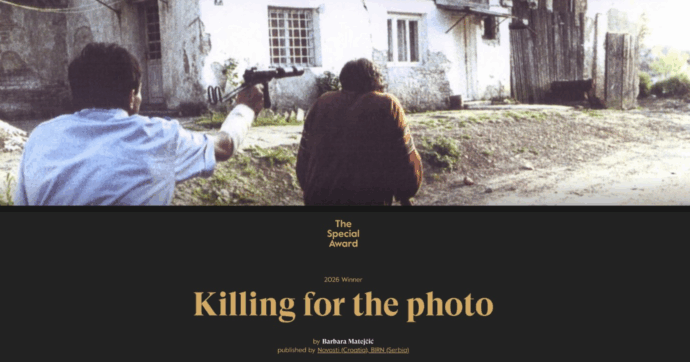
In 1993, a sequence of photographs submitted by Serbian photographer Bojan Stojanović won a World Press Photo award in the Spot News category. The images show a man holding a silenced Skorpion submachine gun standing behind another man in a brown suede jacket, his head hunched between his shoulders. He is then shot in the back of the head.
Thirty-three years later, an extensive investigation by Croatian journalist Barbara Matejčić has shed new light on long-standing questions surrounding the photographs. The only two reporters who documented an execution during the wars in the former Yugoslavia—Stojanović and his colleague Srdžan Petrović—were allegedly warned in advance that they were about to witness a murder staged for the camera. Six journalist organizations, supported by the European Federation of Journalists, have now launched a petition calling on the World Press Photo Foundation to revoke the award.
An Execution Arranged in Advance for Propaganda Images
The photographs are considered the only images to have captured the moment of an execution during the wars in the former Yugoslavia. Taken in the Brčko district in May 1992, they show Serbian paramilitary Goran Jelisić executing Husein Kršo, a Bosnian Muslim civilian. The image was acquired and distributed by Reuters at the time and received the World Press Photo award the following year.
The photograph’s unusual singularity prompted Matejčić to spend three years reconstructing its origins. Her investigation, Killing for a Photo Opportunity, won the European Press Prize and was supported by Journalismfund Europe. According to the investigation, local police and military officials arranged the execution in advance to obtain propaganda images portraying supposed “Serbian victims.”
A False Caption Repeated for Nearly Three Decades
The controversy concerns not only how the photograph was made but also its caption. For almost 30 years, the victim was described as a “Muslim sniper” captured after firing on a Serbian convoy. That account was false: Husein Kršo was in fact a waiter with no connection to the military.
Only in 2022, after Matejčić submitted a video to World Press Photo in which Stojanović himself stated that the victim was a civilian, did the organization amend the caption. It nevertheless declined to investigate the journalist’s allegations about the circumstances in which the photograph was taken.
Calls for Revocation and the Foundation’s Response
In April 2026, associations of independent journalists in Serbia and Bosnia and Herzegovina asked World Press Photo to revoke the award. The request was rejected on June 3, with the foundation citing insufficient evidence to annul the distinction.
The General Meeting of the European Federation of Journalists subsequently adopted a resolution supporting revocation. The SafeJournalists Network also launched a public petition calling on World Press Photo to apply its ethical code properly.
The petition additionally calls for formal recognition of the Kršo family, who learned what had happened to Husein after recognizing him in the award-winning photograph on television in 1993.