Series: Ground control to Major Tom
Photographer: Jakob Andersen
I. Introduction: Background of the IPA Award and an Overview of the Photographer
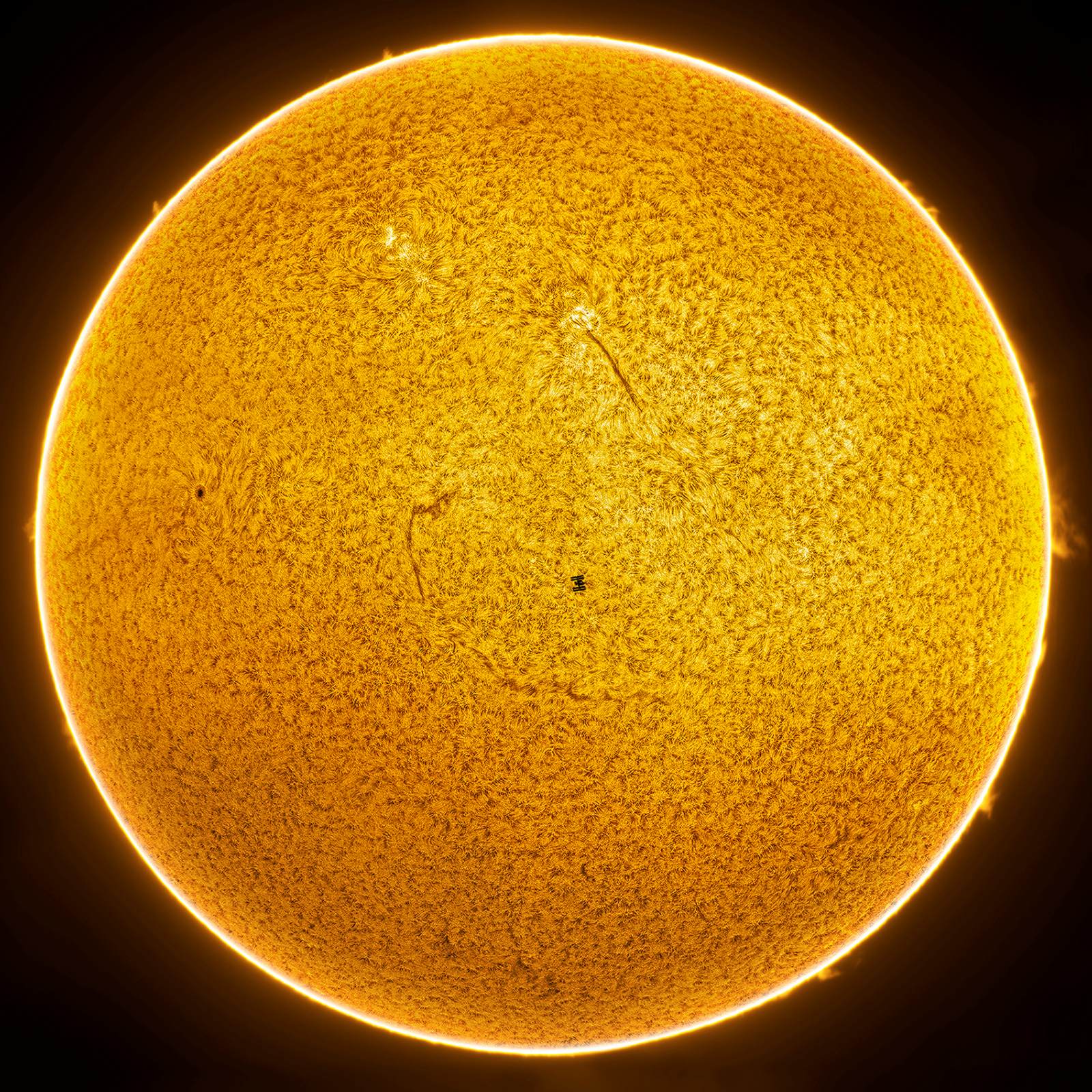
The International Photography Awards (IPA) is one of the most authoritative professional competitions in contemporary global photography, and its roster of winners reflects the cutting-edge explorations of cross-disciplinary visual arts. In the IPA award archive (photoawards.com/social/zoom.php?eid=8-1722620942-26), Danish astrophotography and nature photography artist Jakob Andersen (official registered full name: Jakob Arthur Andersen) was awarded the Nature Photographer of the Year in the IPA Professional Category for his signature work Ground control to Major Tom, which documents the International Space Station (ISS) transiting the solar disk.
Based on the island of Falster in southern Denmark, Jakob Andersen founded the professional photography studio Clearsky Astrofoto. He has long been devoted to solar narrowband monochromatic imaging, deep-sky narrowband nebula capture, nightscape narrative photography, and dark-sky ecological conservation. By integrating precise astrophysical calculation, extreme optical control in harsh environments, and the minimalist Nordic fine-art visual paradigm, he has forged a highly distinctive technical and aesthetic path within contemporary nature photography.
II. Photographer’s Background and Artistic Positioning
Jakob Andersen resides in Horbelev, Falster, located in the Guldborgsund Municipality of the Zealand Region in Denmark. The area, situated away from the core urban clusters of Northern Europe, retains a low light pollution index, providing superior physical conditions for faint-photon capture and extreme astrophotography. Around 2017, Andersen registered and established the Clearsky Astrofoto studio (Danish business registration no. CVR: 42351326), located at Grønsundsvej 292, 4871 Horbelev, Denmark, to systematically advance the production and distribution of gallery-grade astrophotographic fine art prints.
On a philosophical level, Andersen defines astrophotography as a medium for “contemplating the depths of time.” In his artist statement, he explains that when the telescope and sensor are pointed at galaxies and deep-sky nebulae tens to millions of light-years away, the images recorded are essentially historical photons emitted in the distant past and traversing the cosmos. This physical mechanism lends his work a powerful existential metaphor—placing the brief scale of human life against the backdrop of an almost eternal cosmic evolution.
Photographer Profile Overview:
- Core Creative Fields: Solar chromosphere narrowband imaging; deep-sky long-exposure astrophotography; nightscape photography
- Major International Honor: IPA International Photography Awards “Nature Photographer of the Year” (Professional Category Grand Prize)
- Artistic Presentation Mediums: Weather-resistant aluminum panel high-precision UV prints; Danish custom solid wood floating frames (Svæveramme)
III. In-Depth Analysis of the Award-Winning Work Ground control to Major Tom
3.1 Title and Visual Narrative
The title Ground control to Major Tom pays tribute to David Bowie’s iconic space-themed song Space Oddity. The photograph captures the moment the International Space Station, traveling at the first cosmic velocity (approximately 7.66 km/s), transects the solar disk—presenting a striking juxtaposition of human aerospace engineering and stellar nuclear fusion. Within the monochromatic image of the 656.28 nm hydrogen-alpha spectral line, a dialogue between cosmic-scale energy and human precision craftsmanship is frozen into a single frame.
3.2 Key Technical Parameters
| Technical Dimension | Setting & Specification |
|---|---|
| Subject | ISS solar transit trajectory and active structures of the solar chromosphere |
| Primary Optical Telescope | 480 mm focal length / 80 mm aperture high-resolution refractor (480/80 mm OTA) |
| Optical Amplification System | 2.7× custom-grade Barlow lens |
| Narrowband Filter | Daystar Quark Hydrogen-Alpha (H-Alpha, 656.28 nm) solar chromosphere filter system |
| Image Sensor | ZWO ASI174mm Pro high-speed monochrome cooled astronomy camera |
| Single-frame Exposure & Gain | Exposure time 300 ms; sensor gain 200 |
| Award Category | IPA Professional Category: Nature Photographer of the Year |
3.3 Acquisition Mechanism and Extreme Optical Control
The full transit of the ISS across the solar disk typically lasts less than one second, making it a high-bar astronomical transient event. Andersen must contend with exceptionally stringent physical and environmental constraints:
First, geographical projection and trajectory planning. The ground-projected width of the ISS solar transit centerline is usually only a few hundred meters to several kilometers. Based on precise orbital mechanics ephemerides, Andersen drives 20 kilometers to a designated location that meets the requirements for sustained high-power outdoor power supply and lies strictly on the geometric centerline of the transit.
Second, thermal disturbance and focus management. Direct sunlight causes thermal expansion and contraction of the telescope’s metal structure and optical elements, resulting in millimetric drift of the focal plane. Andersen arrives an hour early to set up the equipment and performs nearly an hour of continuous dynamic focusing during the equipment’s warm-up phase, ensuring that the moment the ISS enters the solar disk, the focal plane is precisely locked between the solar chromosphere and the low-Earth orbit spacecraft.
Third, optical separation and formal contrast. The H-Alpha monochromatic filter selectively eliminates the dazzling continuum spectrum, fully revealing the filamentous chromospheric structures, granulation, and magnetic disturbances on the solar surface. The violent dynamics of this microscopic physical scale forms a striking formal contrast and aesthetic tension with the precisely symmetrical mechanical outline of the space station.
IV. Creative System and Craft Characteristics
4.1 Core Series and Narrative Motifs
Through Clearsky Astrofoto, Andersen continuously releases limited-edition themed series, with each edition limited to 30 prints. His creative practice is organized into three main veins:
-
Deep-Sky Cosmic Evolution Series: Including Lost, Uendelighed (Infinity), and Life on Mars?. This series focuses on nebular ionization regions, stellar nurseries, and distant galaxy clusters spanning hundreds of millions of years, exploring the profound beauty of cosmic disorder and material circulation.
-
Solar Dynamics Series: Including Voldsom aktivitet (Violent Activity), Leopard pletter (Leopard Spots), and Artemis II. Using specialized narrowband coronal and chromospheric observation equipment, Andersen freezes solar flare eruptions, prominence ejections, and sunspot group evolution into compositions that combine scientific documentation with abstract expressionist aesthetics.
-
Dark-Sky Landscape Narrative Series: Including The missing light! and Washing away the past. This series focuses on the juxtaposition of pristine Nordic coastlines, residual trees, and brilliant galactic arches. Through the contrast between landscape and starry sky, it reflects on the erosion of pristine nocturnal landscapes caused by human industrial expansion.
4.2 Physical Printing and Mounting Craft
In terms of physical presentation, Andersen has abandoned traditional photo paper—which is vulnerable to environmental humidity and light-induced aging—in favor of the highly weather-resistant Direct Print on Aluminum technique. Combined with industrial-grade UV-resistant curing inks, this process ensures the artworks remain color-stable for decades, while physically maximizing the reproduction of the extreme black-level depth and stellar highlight dynamics found in deep-sky astrophotography. Each aluminum print is factory-mounted in a Danish custom solid wood floating frame (Danish Svæveramme), creating a visual sense of suspension between the image and the wall, thereby enhancing the immersive viewing experience of the deep-sky works.
V. Dark-Sky Advocacy, Public Curation, and Educational Practice
In addition to his gallery art practice, Jakob Andersen actively engages in public dark-sky environmental conservation and the popularization of amateur astronomy, employing photography as a central medium for promoting ecological issues.
5.1 International Dark Sky Park Certification and Landscape Archival Documentation
Andersen maintains close collaboration with DarkSky International and Danish domestic nature conservation organizations. In the process of Anholt island’s application for and approval as Denmark’s fourth International Dark Sky Park, he provided core visual documentation and dark-sky quality assessment materials. Additionally, he has long been engaged in establishing dark-sky archival records for zero-light-pollution nature reserves such as Tryggelev Nor in southern Langeland, Denmark—visually demonstrating, through imagery, the importance of dark-sky resources for migratory birds and nocturnal wildlife habitats.
5.2 Touring Lectures and Hands-on Workshops
To make professional astrophotography techniques accessible to a wider audience, Andersen conducts multi-tiered public education programs year-round:
-
Science Lecture “NAT” (Night): Through high-lumen large-format projection, he showcases deep-sky wonders millions of light-years away, systematically explaining the physical mechanisms of stellar birth, supernova explosions, and nocturnal optical recording. He has been invited as a featured speaker at Denmark’s renowned KANT Arts and Culture Festival.
-
Field Workshops: Regularly held in southern Denmark as overnight photography courses (typically running from 20:00 to 02:00 the following morning). The curriculum covers high-precision polar alignment of star trackers, signal-to-noise ratio control of low-light sensors, capture of dark frames and flat frames, as well as multi-layer astrophotographic stacking and noise reduction workflows using PixInsight and Photoshop.
-
Local Art Ecosystem Building: For many years, Andersen has continuously participated in the Guldborgsund Open Studio Doors art festival (Åbne Atelierdøre Guldborgsund), regularly opening his Horbelev observatory and art studio to the public, thereby fostering direct interaction between the local community and contemporary astrophotographic art.
VI. Contemporary Value within an Art-Historical Perspective and Academic Conclusion
Jakob Andersen’s receipt of the IPA Professional Category Nature Photographer of the Year award signals the recognition of and emphasis on “interdisciplinary naturalism” by the international mainstream photographic academic establishment. Traditional nature photography has long focused on macroscopic landscapes, wildlife, or terrestrial flora; Andersen’s work breaks through the limitations of an anthropocentric / geocentric perspective, extending the scope of “nature” to encompass near-Earth space dynamics and astrophysical dimensions.
In Ground control to Major Tom, through precise optical control, Andersen fuses the space station—representing the pinnacle of human civilizational engineering achievement—with the stellar nuclear fusion reactions that sustain the solar system, on a single plane. This highly precise “decisive moment” is both a tribute to physics and orbital geometry, and a philosophical reconfiguration of the relationship between nature and human creation. With his profound technical foundation in astrophysics, his meticulous mastery of physical media, and his sustained commitment to dark-sky ecological conservation, Jakob Andersen has established his leading position in contemporary European astrophotography and nature photography.