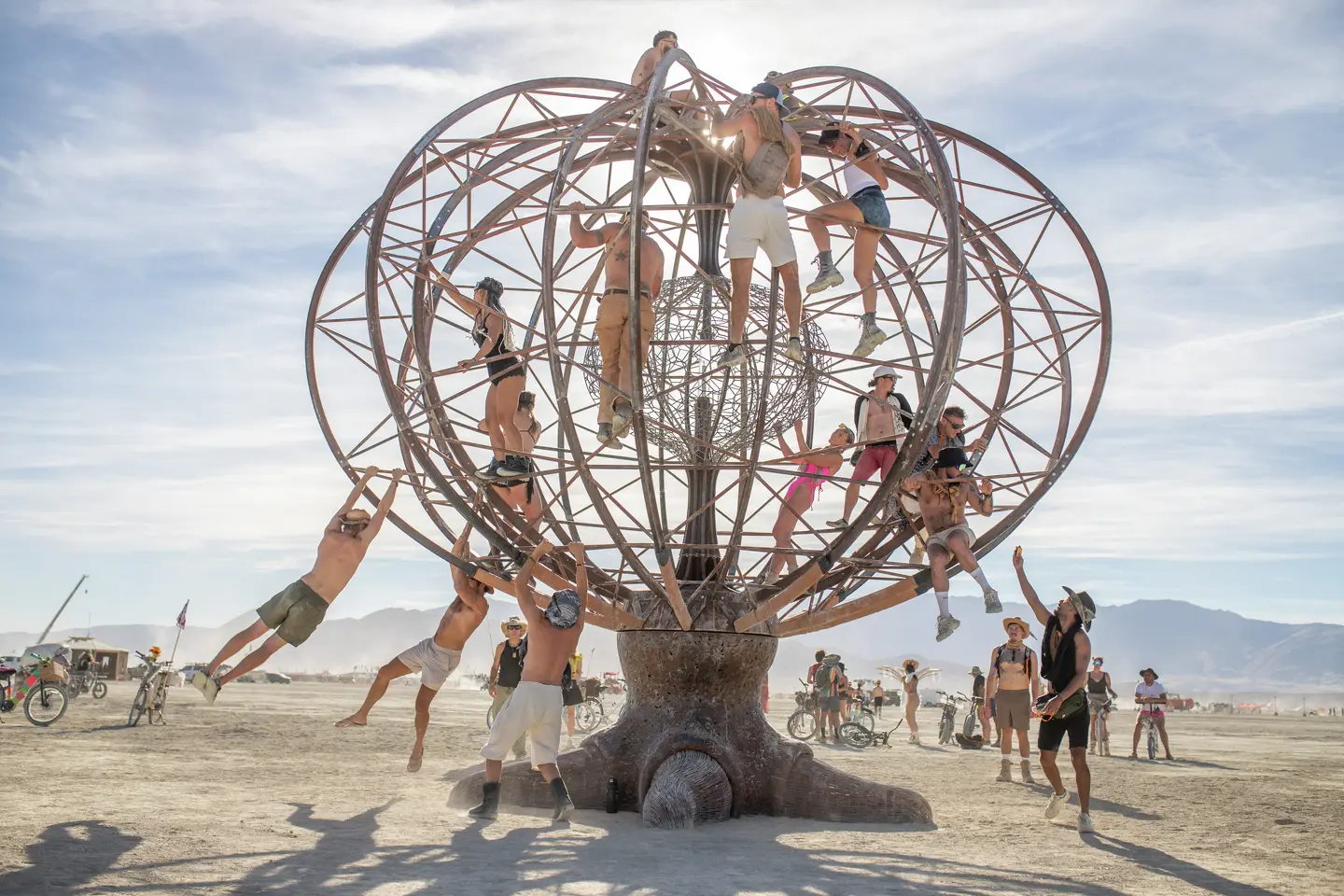
Michael Christian’s ePod at Burning Man 2026 in the Black Rock Desert of Nevada.
Jane Hu/For SFGATE
I. Event Overview and Annual Theme
The 2026 Burning Man takes place from August 30 to September 7, 2026 (coinciding with the U.S. Labor Day holiday) in the Black Rock Desert, Nevada, USA. It is expected to attract more than 70,000 participants from over 100 countries.
The theme of this year is “Axis Mundi” (World Axis), a concept derived from mythology and cosmology, symbolizing the central hub of the universe that connects heaven and earth. In response to this theme, the installations this year generally exhibit the following visual characteristics: geometric structures extending vertically toward the sky, biomimetic forms intertwining like DNA and tree roots, as well as digital nighttime landscapes with sound-and-light interactions. Unlike previous years, which were dominated by muddy environments, this edition is set against a backdrop of gusty winds and alkaline dust-filled sandstorm light and shadow, providing photographers with dramatic diffused light and a cinematic texture.
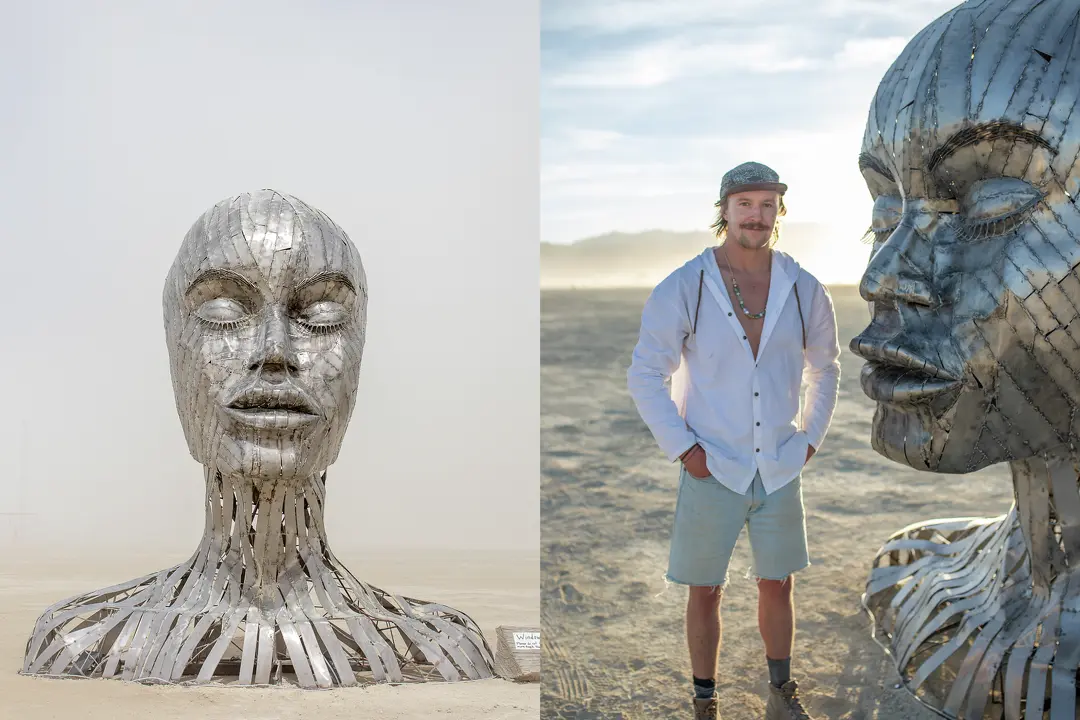
Windswept by Dylan Hird, pictured, at Burning Man 2026 in the Black Rock Desert of Nevada.
Jane Hu/For SFGATE
II. Core Art Installations of This Year
The following installations appear most frequently in documentary reports by on-site photographers (such as SFGATE contributing photographer Jane Hu and others):
| Installation | Artist / Team | Visual Features & Photographic Focus |
|---|---|---|
| Cryptomeria (2026 Man Pavilion) |
Alexander “Zander” Rose | The most direct architectural representation of “Axis Mundi.” The base features a giant tree-root-like walkway, with external stairs spiraling nearly 60 feet to the center, and a double-helix DNA vertical structure at its core [6-8] |
| Temple of the Moon | James Gwertzman & Moonlight Collective | Spanning approximately 170 feet, with 8 arches (symbolizing moon phases). The top petals are inspired by the “Queen of the Night” cactus (blooming at sunset, closing at sunrise), creating an extremely strong ritual atmosphere in nighttime light and shadow [8-10] |
| Eiffela Broken Dream | Philippe Maindron | A darkly humorous visual impact. A 1:10 scale metal Eiffel Tower thrust into the ground like a meteor, serving as an excellent foreground against the desert horizon |
| TITANIC | Not specified in the source | A giant explorable sculpture depicting the Titanic broken in two and sinking into the desert. Combined with flame effects, lighting, and crowd interaction, it is expected to become one of the most attention-grabbing art projects of 2026 [11-13] |
| Axis Mundi: Resonant Spire | Sergei Konchekov | A 33-foot-tall landmark in the deep desert. Composed of progressive cones and programmable halos, with light waves leaping layer by layer toward the sky — a popular subject for nighttime long-exposure and time-lapse photography [14-16] |
| Do Baskets Dream of Shores or Sea | Luke Lin & Auroborium | Eastern imagery: 7 traditional Vietnamese bamboo-woven boats set in endless yellow sand, accompanied by a sea of lantern light, creating a poetic atmosphere in the morning advection fog |
| LOOKOUT! | Franzi Ponzi & Homo Erectors | An absurdist megastructure. A 48-foot-tall fire lookout tower disguised as a giant fire extinguisher, focusing on wildfire and climate issues |
| Mundara | Art Rising Collective | A giant yoga-meditation human-form sculpture, using natural woven materials that present rich textural detail under the soft light of sunrise |
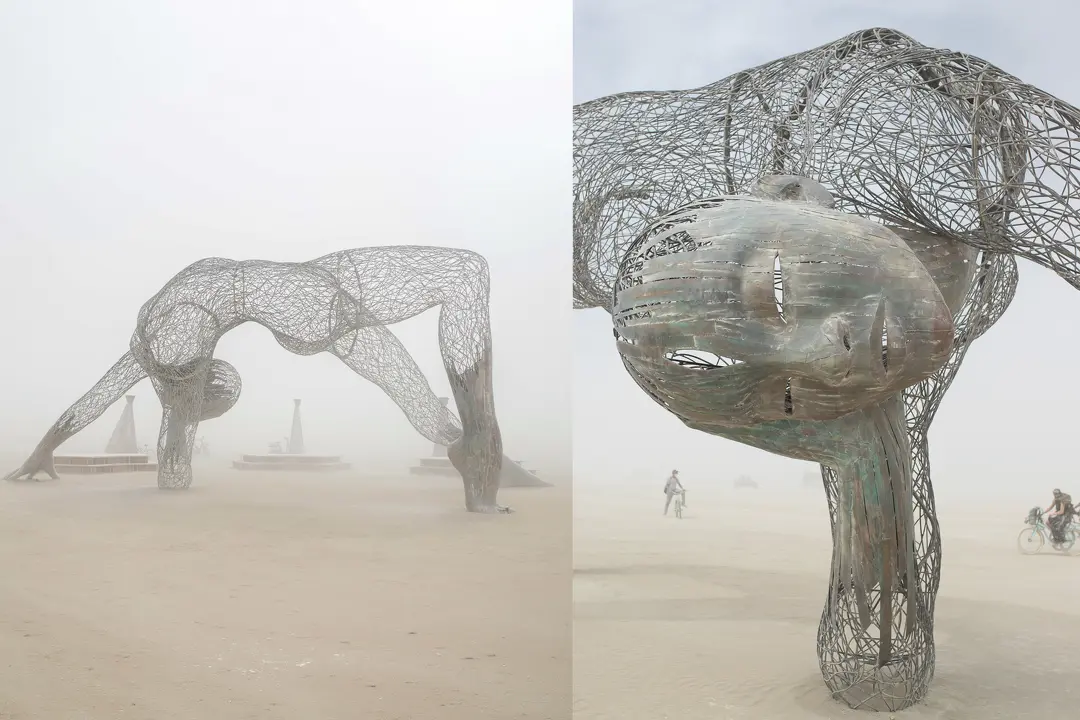
Mundara by the Art Rising Collective at Burning Man 2026 in the Black Rock Desert of Nevada.
Jane Hu/For SFGATE
III. Key Event Timeline
Burning Man spans 9 days, and photographic opportunities are highly concentrated around specific ritual moments. The core events, in chronological order, are as follows:
By Burning Man tradition, Saturday night is fixed as the “Man Burn,” and Sunday night as the solemn “Temple Burn.” The two differ dramatically in ritual tone, emotional atmosphere, and shooting techniques.
| Time Point | Core Event | Photography Techniques & Composition |
|---|---|---|
| 8/30 (Sun) Dusk—Evening | Gate Opening | Long-exposure vehicle light trails, silhouettes of dust-protected convoys entering the desert, city lighting ceremony |
| 8/31—9/4 (Weekday Mornings) | Dawn Patrol | 06:00—07:30, dust settles and temperatures are cool; low-color-temperature morning light outlines the lines of deep-desert megastructures |
| 9/5 (Sat) from 20:00 | The Man Burn | Carnival atmosphere, fireworks matrix, hundreds of thousands of lumens of flame illumination; secure an upwind position 3 hours in advance to avoid thick smoke and heat waves blowing directly into the lens |
| 9/6 (Sun) from 20:00 | Temple Burn | Absolute silence (Silent Burn), flames rising vertically, solemn crowd; use of any supplemental lighting or mechanical shutter bursts is strictly prohibited |
| 9/7 (Mon) All day | Exodus | Tens of thousands of RVs line up to depart, forming an apocalyptic vehicle procession converging amid dust storms |
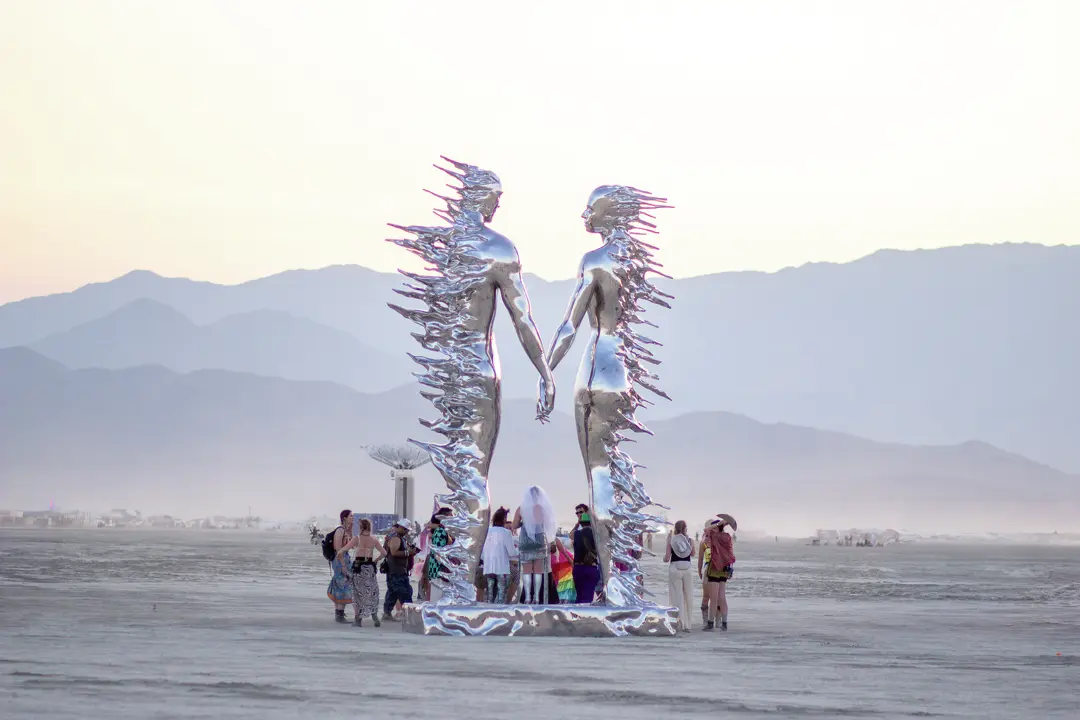
Sculpture by Michael Benisty at Burning Man 2026 in the Black Rock Desert of Nevada.
Jane Hu/For SFGATE
IV. Survival Guide for Photography Gear in Extreme Environments
The Black Rock Desert is notorious for its highly corrosive fine alkaline dust and sudden dust storms, which pose a deadly threat to photographic equipment. In actual desert practice, gear protection takes priority over image quality — a photographer whose camera body fails due to sand ingress will lose shooting opportunities for the entire event.
4.1 Basic Protection Principles
Strategies employed by experienced photographers include:
- Sealing the Equipment: Use Gaffer’s Tape to seal the non-essential seams and buttons of the camera, or wrap the camera in a plastic bag/rain cover.
- Avoid Changing Lenses: Never take out the camera or change lenses during a dust storm. Prime lenses are recommended, because the bellows effect of zoom lenses can suck dust into the camera body.
- Carry a “Sacrificial” Backup Body: Experienced photographers often use an old DSLR (e.g., a 10+ year-old model) or a cheap backup as their main tool, because even with proper protection, the gear may still require professional deep cleaning or even be rendered unusable afterward.
- RAW Format Recording: It is recommended to shoot in RAW format throughout, so that exposure and white balance errors caused by harsh desert light or nighttime flames can be rescued in post-processing.
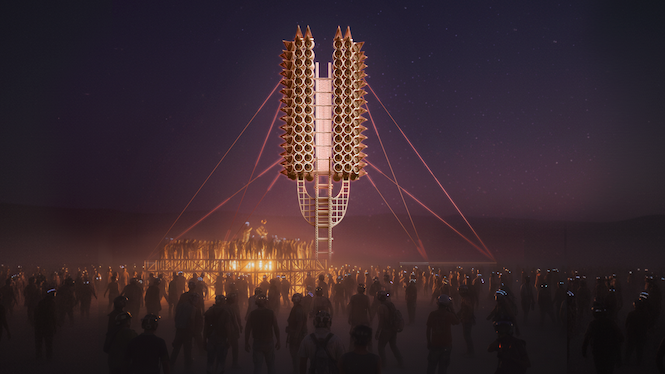
“Axis Mundi- Resonant Spire” by Sergei Konchekov, 2026
4.2 Recommended Gear Configuration
The core of the desert gear strategy is fully sealed dust protection and zero outdoor lens changes:
| Category | Professional Configuration | Key Field Details |
|---|---|---|
| Camera Body (Dual Setup) | 2 weather-sealed full-frame bodies (e.g., Sony A7R/A1, Nikon Z8/Z9, Canon R5) | One body for wide-angle, one for telephoto; never open the mount to change lenses outdoors throughout the entire event; seal mount seams tightly with Teflon electrical tape |
| Lens Combination | Mobility Trio: ① 16-35mm f/2.8 (architecture & large scenes) ② 50mm/85mm f/1.4 (environmental portraits) ③ 70-200mm f/2.8 (flames, distance, spatial compression) | Zoom rings with external zoom structures are prone to jamming — prioritize internal zoom lenses; keep a high-quality UV filter screwed on at all times to protect the front coating |
| Filters & Protection | High-quality CPL polarizer, ND8/ND64 filters, professional silicone dust-proof rain cover | CPL used to filter dust glare and enhance sky saturation; seal the body with a rain cover, exposing only the front lens element and viewfinder |
| Storage & Power | CFexpress Type B / V90 SD cards, rugged portable SSDs (e.g., SanDisk Extreme Pro / LaCie Rugged), dedicated sealed battery cases | Temperatures above 40°C can cause sudden battery voltage drops; perform daily dual-SSD mirror cold backups to a directly connected laptop at camp |
| Cleaning & Maintenance Kit | Manual blower (with red intake valve), high-fiber lens tissue, anhydrous isopropyl alcohol cleaning wipes, soft-bristled makeup brush | Never blow directly onto the sensor in the desert; brush dust from body seams with the brush before entering the tent — never use a wet cloth to wipe alkaline-dusted body surfaces to avoid chemical reactions |
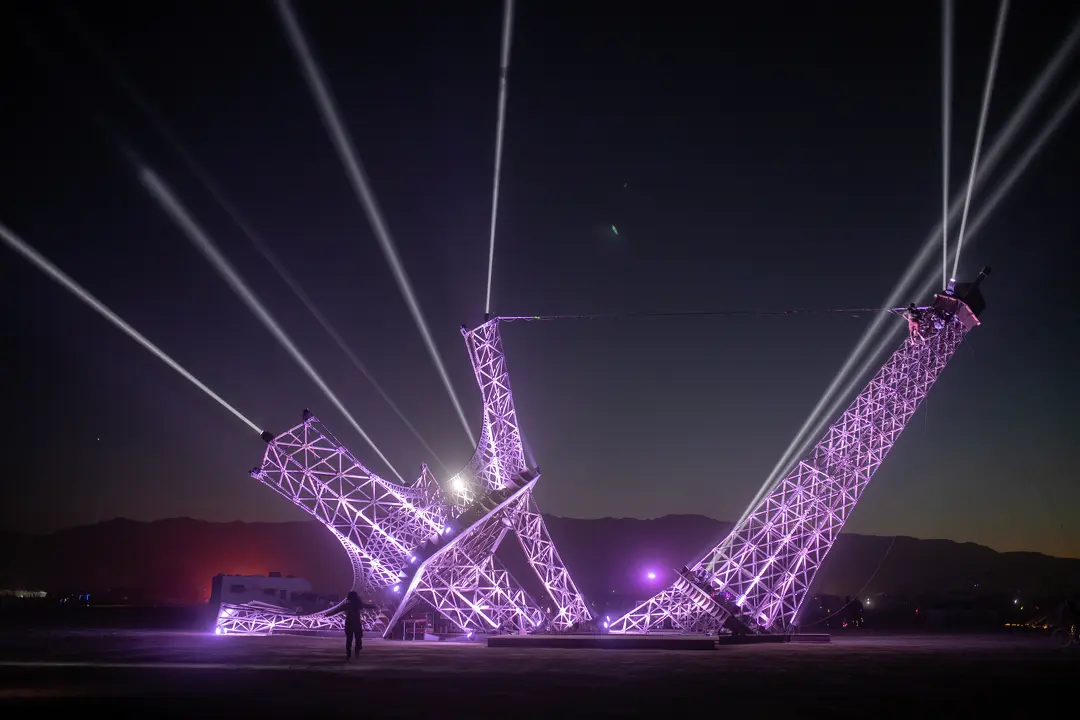
Eiffela Broken Dream by Philippe Maindron at Burning Man 2026 in the Black Rock Desert of Nevada.
Jane Hu/For SFGATE
V. Key Shooting Windows and Photographic Trends
5.1 Golden Shooting Windows
- Early Morning 6:15—7:30 (Golden Morning Light): The most stable shooting window in the Black Rock Desert. Wind dies down, dust storms weaken, temperatures are cool, and crowds around installations are sparse — the best time to capture clean architectural lines.
- Evening 19:30—20:30 (Twilight Meets LED): After the sunset afterglow sinks into the mountains, the deep blue sky forms a strong warm/cool contrast with the glowing Mutant Vehicles and dynamic light installations.
- Burn Night (see Section III Timeline): Flames illuminate installations and crowds — a uniquely dramatic light source at Burning Man. The Man Burn requires an upwind position; the Temple Burn requires absolute silence to honor the ceremony’s solemnity.
5.2 Portrait & Documentary Photography
Burning Man brings together an extreme density of radical human self-expression, but shooting depends heavily on light management and ethical boundaries.
Light Windows and On-Site Light Modulation:
- Avoid Harsh Noon Light (11:00—16:00): The desert ground is a highly reflective white alkali flat; direct noon light will cause deep shadows in the eye sockets and overexposed cheeks of subjects.
- Golden Half-Hour at Sunrise (06:15—06:45): Use low-angle warm backlight to outline feathers, leather, and metallic details of costumes, and treat dust diffusion as a natural reflector.
- Mutant Vehicles and Environmental Fill: At night, abandon bulky off-camera flash setups (easily toppled or crashed by wind and sand). Use compact, high-CRI (≥95) handheld light wands, or directly use the neon/laser on art cars as rim light.
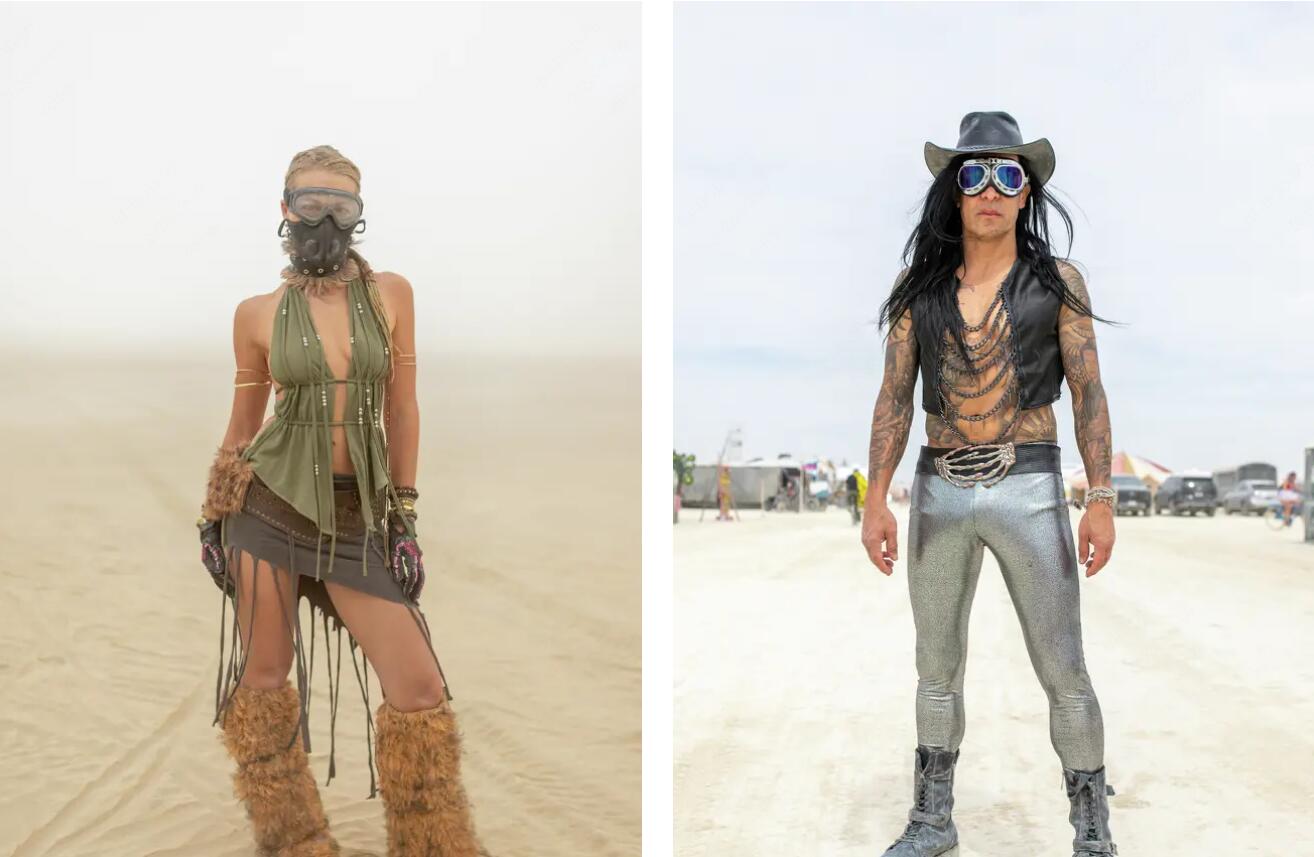
Sasha Ivanova, left, and Oswaldo Toro at Burning Man 2026 in the Black Rock Desert near Gerlach, Nev.
Jane Hu/For SFGATE
Informed Consent Communication Templates:
-
One of Burning Man’s core principles is mutual respect. When shooting candid large-scale scenes, the “ask first, then shoot” principle must be followed.
-
Practical Communication Template:
“Hi, your attire and energy are incredible. May I take a portrait of you with this installation?”
-
Gifting Linkage: Immediately playback the photo to the subject after shooting, and prepare a small card printed with personal contact info or a unique album-receiving QR code, promising to send high-resolution original files free of charge after the event — integrating the act of photography into the culture of “unconditional gifting.”
5.3 2026 Technical and Aesthetic Trends
- Flash-Free Night & AI Computational Photography: Flash ruins the environmental atmosphere and illuminates dust in the air. This year’s trend is to leverage smartphone AI computational photography (e.g., iPhone 17 Pro) and image stacking, or to rely on ambient light sources such as DJ booth neon and firelight to capture authentic nighttime scenes.
- Dust Haze Aesthetics: Photographers extensively use telephoto lenses to compress backlit silhouettes through dust, creating the uniquely post-apocalyptic and surreal Burning Man atmosphere.
- “Lo-Fi” Authenticity: As AI-powered perfect retouching becomes widespread, film grain, motion blur, and imperfect framing — qualities that convey a “human presence” — have become powerful tools against AI-generated imagery.
- Vertical Composition Priority: To adapt to platforms like TikTok, Instagram Reels, and YouTube Shorts, the 9:16 vertical format has become the default framing option.
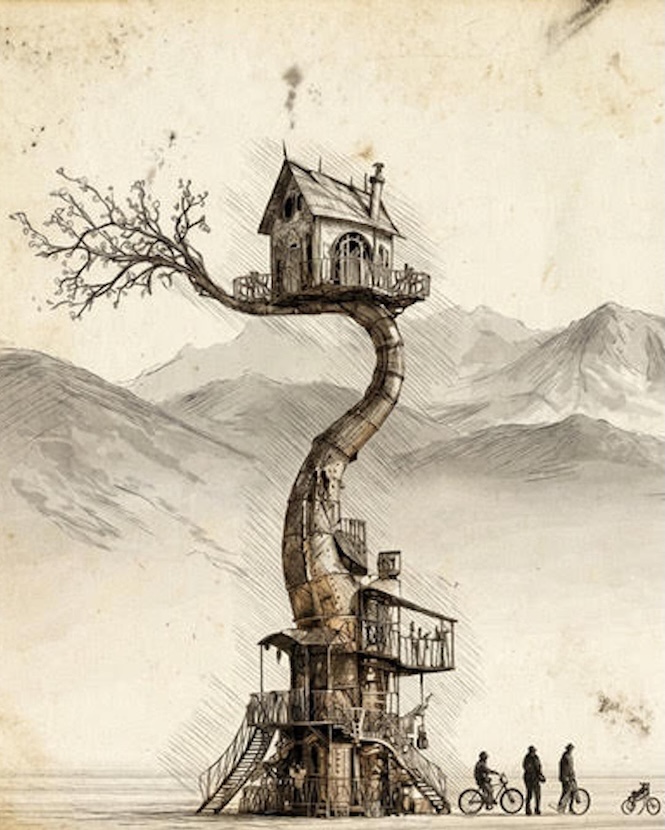
“Above and Below” by Sean Orlando, 2026
VI. Post-Processing Workflow
The extremely fine alkaline dust in the Black Rock Desert causes high light scattering, and straight-out-of-camera RAW files often suffer severe shadow contrast loss, blown highlights, and color temperature disorder. The core of professional post-processing is restoring high dynamic range + preserving dust texture + warm/cool color grading.
6.1 High Dynamic Range and Tonal Recovery
The environmental dynamic range under direct desert sunlight often exceeds 14 EV. In Adobe Camera Raw / Lightroom, avoid globally pulling Contrast directly. Suggested parameters:
- Highlights: -60 to -80 (compress highlights)
- Shadows: +30 to +40 (moderately lift shadows)
- Blacks: -15 to -25 (force black point to recover the “washed-out gray” caused by dust diffusion)
6.2 Alkali Dust Noise Reduction and Texture Preservation
High ISO at night (3200—12800) combined with suspended alkali dust generates dense chroma noise in smooth sky areas. When using AI denoising (e.g., Lightroom Denoise or Topaz Photo AI):
- Keep detail preservation at 45%—55%; over-smoothing destroys the sand grain texture
- Use Texture +15 instead of Clarity to prevent hard white halos around dust particle edges
6.3 Warm/Cool Split Grading for Firelight and Night Sky
During the burn ceremonies, wood and chemical pyrotechnic flames burn at 1800K—2400K, and the camera’s auto white balance tends to drift the entire image toward yellow. Post-processing suggestions:
- Lock global white balance at 3200K—3600K
- Use the color grading panel to apply orange-gold (Hue 35°) to highlights and deep cobalt blue (Hue 215°) to shadows and neutral grays for sharp warm/cool contrast
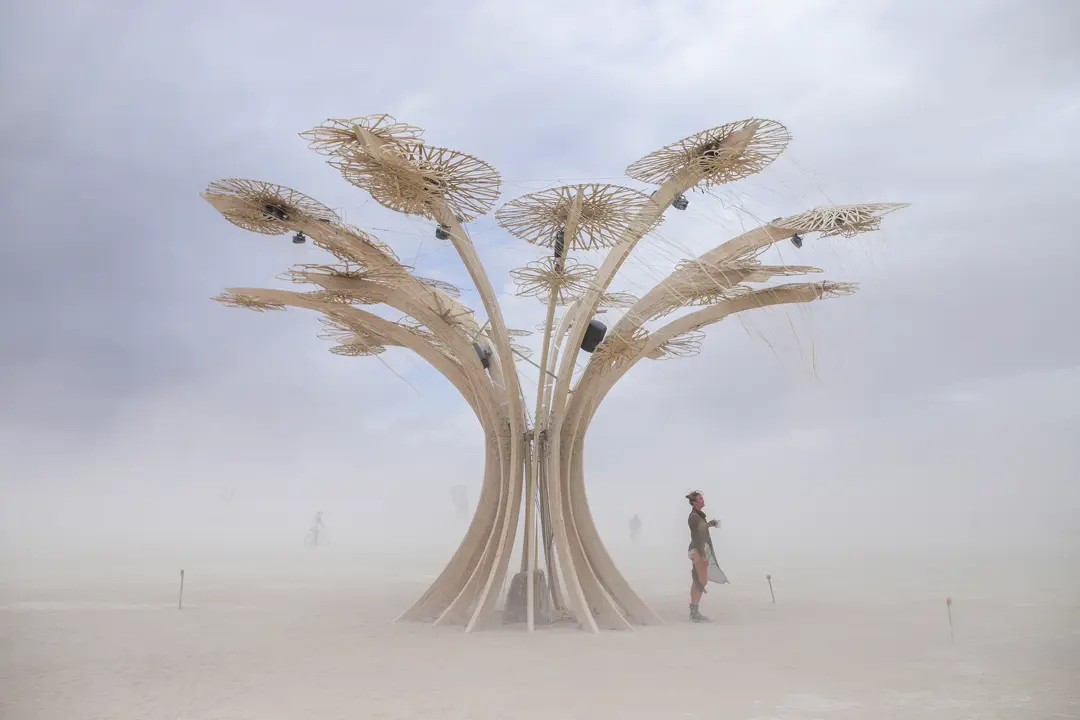
Yggdrasil by Morten Ortenblad at Burning Man 2026 in the Black Rock Desert of Nevada.
Jane Hu/For SFGATE
VII. Media Rules and Photographic Ethics
Burning Man is a private event that emphasizes the principle of “Decommodification,” and its shooting regulations are extremely strict:
- “Ask First” Principle: Always obtain explicit consent before photographing anyone (especially involving nudity or vulnerable private emotional states) — never ambush-style paparazzi-style shooting.
- Strict Boundary Between Personal and Commercial Use: Photos for personal social media sharing require no registration. However, any shooting for commercial profit, publication, wide distribution, or portfolio promotion must apply in advance for a Media Tag at “Media Mecca,” and sign a professional usage contract and obtain portrait rights authorization. The organization also strictly prohibits using on-site photos for commercial advertising, product endorsement, or sponsor placement, and prohibits bundled sales to traditional micro-stock agencies.
- Temple Shooting Taboos: The Temple of the Moon is a sacred space for mourning and contemplation. Personal shooting is allowed only when no recognizable private offerings are visible; any shooting that includes other people or private offerings is strictly prohibited. The organization and volunteer Temple Guardians jointly maintain the mournful and sacred nature of this space.
- Absolute Red Lines: It is strictly forbidden to secretly photograph unclothed or spiritually altered participants; during Temple Burn night, no supplemental lighting or mechanical shutter bursts are allowed, in order to preserve the silence and solemnity of the ceremony.
- Drone Control: All UAVs must be registered and approved in advance through BRC Drone and labeled; taking off unannounced over crowds or above burn ceremonies is strictly prohibited.
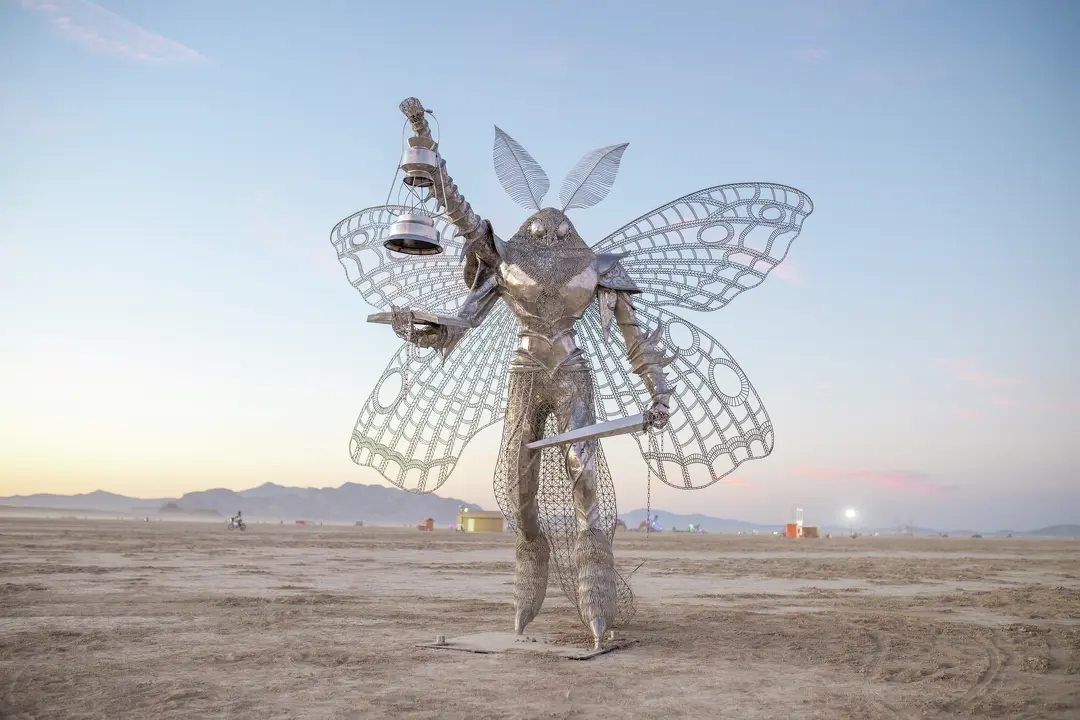
Moth by Vitalii Kusaiko at Burning Man 2026 in the Black Rock Desert of Gerlach, Nev.
Jane Hu/For SFGATE
VIII. Survival and Health Guide
Image quality is entirely built upon survival guarantees. In the extreme dryness and high-altitude desert with dramatic temperature swings (over 40°C during the day, down to nearly 5°C at night), photographers must be self-reliant.
8.1 Hydration and Heat Exhaustion Prevention
Photography with heavy gear accelerates fluid loss:
- A 3+ liter water bladder must be carried in the camera bag; daily water intake should not be less than 4—5 liters
- Drinking pure water alone causes hyponatremia; oral rehydration salts (ORS) or effervescent tablets must be added in proportion
- If sweating stops or dizziness occurs, immediately retreat to shade and stop shooting
8.2 Respiratory and Corneal Protection
The Black Rock Desert is composed of fine alkaline carbonates from a dry lakebed; inhalation causes “Playa Cough,” and eye contact causes chemical conjunctivitis:
- Always carry sealed dust-proof goggles (not ordinary sunglasses) and a P100/N95-grade dust respirator mask
- Carry single-use artificial tears; never rub your eyes in the dust
8.3 Vehicle Mobility and Night Lighting Safety (Dark Wad Prevention)
Within the 7-square-mile Black Rock City, a beach cruiser bicycle equipped with puncture-resistant inner tubes (Slime/Tuffy Liner) is the primary means of transport:
- All-directional illumination is required for both person and gear at night: Black Rock City is full of motor vehicles and Mutant Vehicles at night; unlit pedestrians are called “Dark Wads” and are at high risk of fatal collisions
- Photographers must wrap their straps, tripods, and bicycles with high-brightness EL wire, and equip strong front and rear bike lights
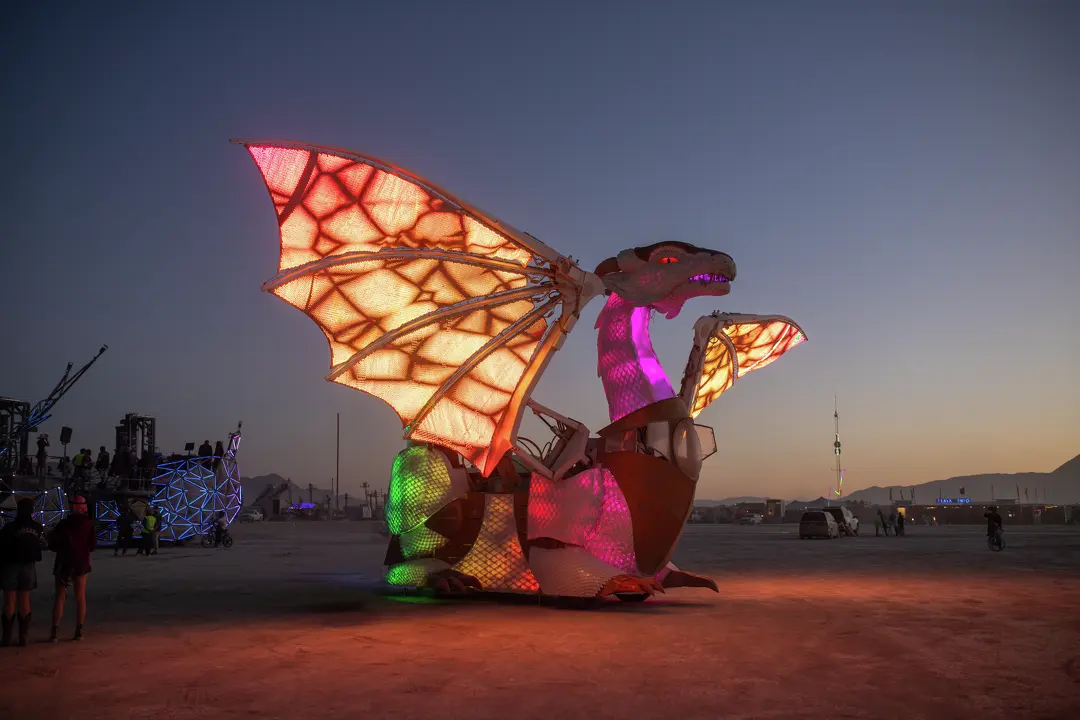
Elektra art car by Engineered Artworks at Burning Man 2026 in the Black Rock Desert of Nevada.
Jane Hu/For SFGATE
IX. Burning Man History and Cultural Background
If photographers do not understand the countercultural core behind Burning Man, the resulting photos will often be reduced to superficial spectacle and visual gimmickry.
9.1 Historical Origins: From a Beach Bonfire to a Desert Temporary Utopia
- Burning Man originated on the Summer Solstice of 1986, when Larry Harvey, Jerry James, and a dozen friends spontaneously burned an 8-foot-tall wooden figure and a wooden dog on Baker Beach in San Francisco, symbolizing radical self-purification and emotional release.
- In 1990, the gathering merged with the San Francisco Cacophony Society’s “Dadaist expedition” and officially relocated to the Black Rock Desert in Nevada, gradually evolving into a radical art experimental city built by tens of thousands of people.
9.2 Ten Core Principles Through the Camera’s Lens
- Decommodification: There is no commercial advertising, sponsor branding, or cash transactions in the city (only ice and coffee are sold at Center Camp). Photographic images must exclude all commercial brand placement; photos may not be used for any unauthorized commercial endorsements or advertising.
- Radical Self-expression: Photographers are encouraged to abandon traditional salon-style posing and capture participants’ installations, costumes, and body language that are entirely driven by inner spiritual motivation.
- Leaving No Trace (MOOP): Lens caps, battery wrappers, and tape scraps discarded by photographers during transitions are all MOOP (Matter Out of Place) and must be carried with them at all times, restoring the pristine ground when leaving the desert.
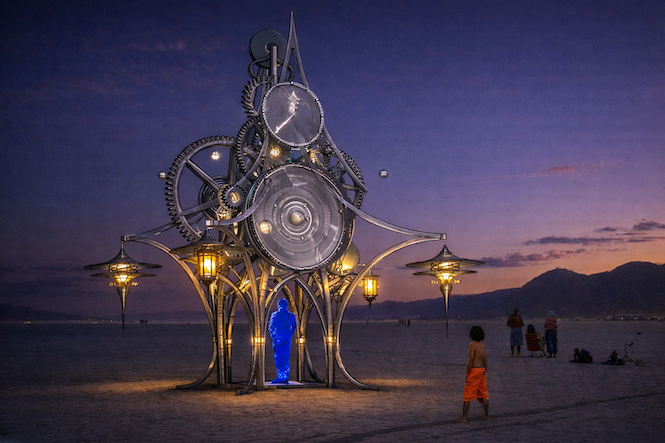
The Sound of Time by Adrian Landon at Burning Man 2026 in the Black Rock Desert of Nevada.
X. Regional and Geographical Planning
Black Rock City is designed with rigorous geometry, presenting a giant horseshoe-dial structure that extends from the 2:00 to 10:00 positions.
                12:00 (Trash Fence)
                     \     /
                      Temple
                        |
                     The Man
                     /     \
    10:00 <======== Center Camp ========> 2:00
          \          (6:00)           /
           \                         /
            \===== Esplanade =======/
Photographic Features of Key Functional Zones:
- Esplanade: The innermost arc of the half-circle city, directly facing the open Playa. This is the front line where Theme Camps compete to display their visual identity — the densest concentration of interactive installations, sound stages, and main-street parades, and the core zone for all-day street documentary and humanistic interaction.
- Center Camp & the 6:00 Avenue Axis: The administrative and public nerve center of the city, gathering the central acoustic stage, lecture venues, and performance art — ideal for mid-telephoto documentary shots of indoor-outdoor transitional humanistic light.
- The Man & The Temple Core Axis: The two landmarks on the city’s central axis. The Man sits at the center of the dial, symbolizing the gathering and dispersion of energy and revelry; The Temple sits deep in the 12:00 direction, a quiet and towering space with unparalleled symmetrical architectural perspective at dawn and dusk.
- Deep Playa (Outer Desert): The open desert extending from the dial’s edge to the pentagonal Trash Fence. Scattered with unlabeled large interactive machines, independent art installations, and solitary mobile architecture, with an empty and pristine background — the prime location for minimalist desert landscapes and sci-fi wasteland-style imagery with telephoto lenses and large apertures.
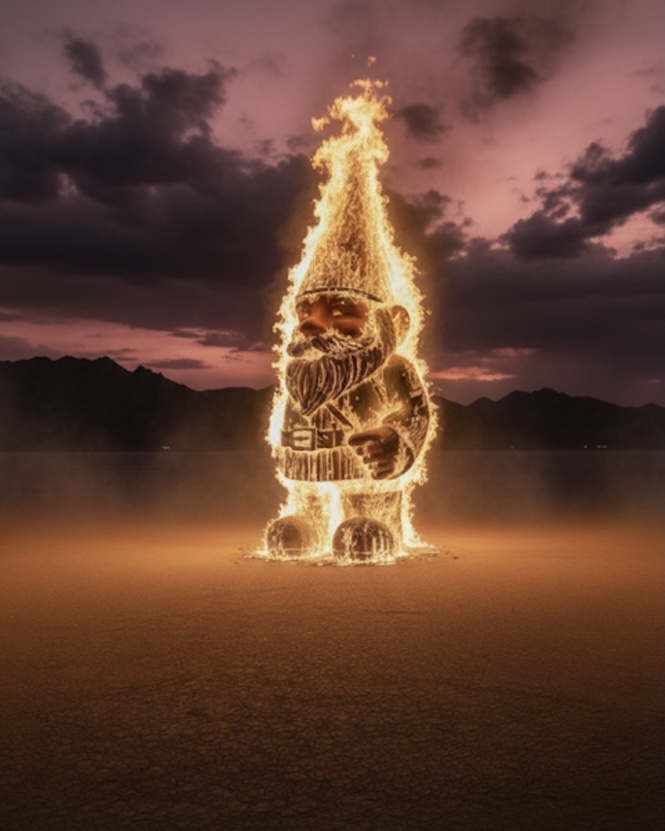
“Fire Gnome” by Fire Gnome Collective, 2026
XI. Community Giveback by Photographers
Under Burning Man’s spirit of “gifting,” many photographers give their work back to the community. Award-winning photographer Mark Fromson, who has served multiple times on the official documentation team, held a Burning Man photography solo exhibition in 2026, and at his own expense printed photos as cards to gift to the creators of artworks (which will be burned after the event), leaving them with an eternal memento.
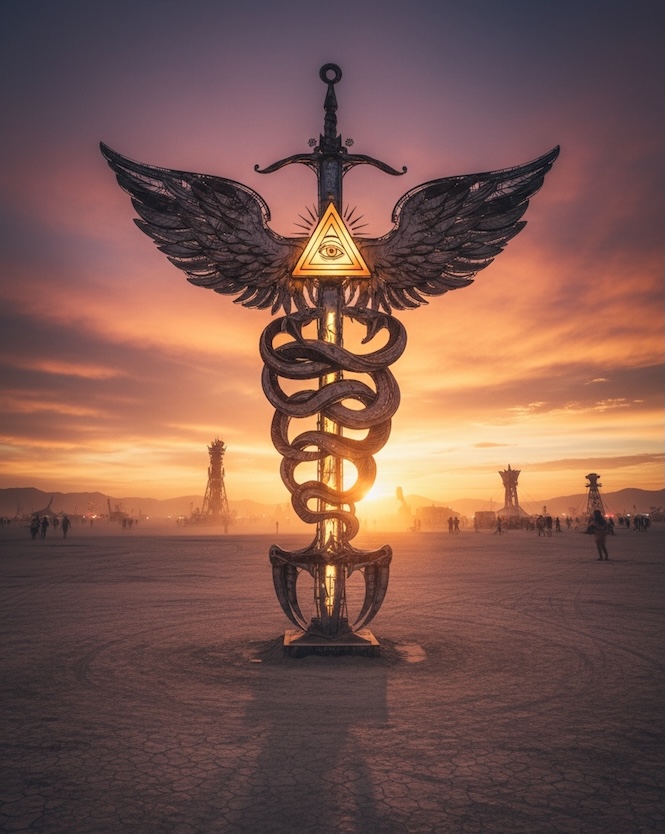
“For They Know Not What They Do” by Jai Hackl, 2026
XII. Conclusion
Burning Man is far more than an outdoor party — it is an art city that grows temporarily in the desert and is completely erased nine days later, a utopian experiment in which tens of thousands of people collectively test self-reliance, radical self-expression, and unconditional gifting under extreme conditions. The “Axis Mundi” theme lends this 2026 edition a rare metaphysical height: the vertically soaring installations, the biomimetic intertwining forms, the vertically rising temple flames — all ask the same question in one language: how do human beings re-establish connection with the heavens, the earth, and with one another.
For the photographer, the Black Rock Desert is at once the most generous of sets (cinematic dust-diffused light, an unprecedented density of human expression, and 24-hour non-stop ceremonial drama) and the most severe of trials (alkali dust erosion, cold nights, communication isolation, and no power supply). It forces the photographer to return to the two most primitive core abilities of photography: sensitivity to light, and respect for people — the former lets you discern the golden moment at 06:15 amid the overhead-light sandstorm, the latter makes you speak the words “May I take a portrait of you?” before pressing the shutter.
When the festival ends and the dust storm raised by the Exodus convoy obscures the last wisp of twilight, what remains on the hard drive is not just a set of images, but a unique civilizational slice earned by the photographer through nine days of sleep, water, lens cleaning, and cultural understanding. These photos will eventually turn to ash and memory, just like the Temple — but that is precisely why they deserve to be shot with the most serious attitude.