
AIScientists think they’ve discovered a much better way to determine whether a photo you’ve seen was AI-generated—and no, it doesn’t rely on AI detection software.
In a study published today in the Proceedings of the National Academy of Sciences (PNAS), researchers from Australian National University say they used a special method to train a group of participants to recognize AI-generated faces, in some cases with “near-perfect accuracy.”
AI-generated deepfakes have surged in both popularity and technical capabilities over the past year. From 2023 to 2025, the volume of deepfakes online exploded, growing by roughly 900% annually as AI-driven image generators improved. Once laughably easy to identify, AI slop has become harder to differentiate from the real thing. Previous studies found that people’s overall accuracy in identifying AI-generated content was essentially a coin toss, with the odds even worse when distinguishing AI-generated faces from actual human faces.
The implications are frightening, especially for people who have been victims of AI-related fraud, disinformation, or non-consensual sexual deepfakes.
Previous methods for detecting AI-generated deepfakes have mostly relied on spotting visual errors: warped backgrounds, anatomical glitches, or telltale mistakes like missing fingers. But as AI image generators have become more precise, those cues have become far less reliable. Commercial AI-detection tools are not a perfect substitute, either. They can produce false positives, and because many of them are AI-driven themselves, the reasoning behind their conclusions is often hidden from the user, making it harder to know when the result should be trusted.
“Lacking an AI answer to the deepfake problem, we urgently need to improve human AI-detection capabilities,” the researchers from the Emotions and Faces Lab at the Australian National University write in the PNAS paper.
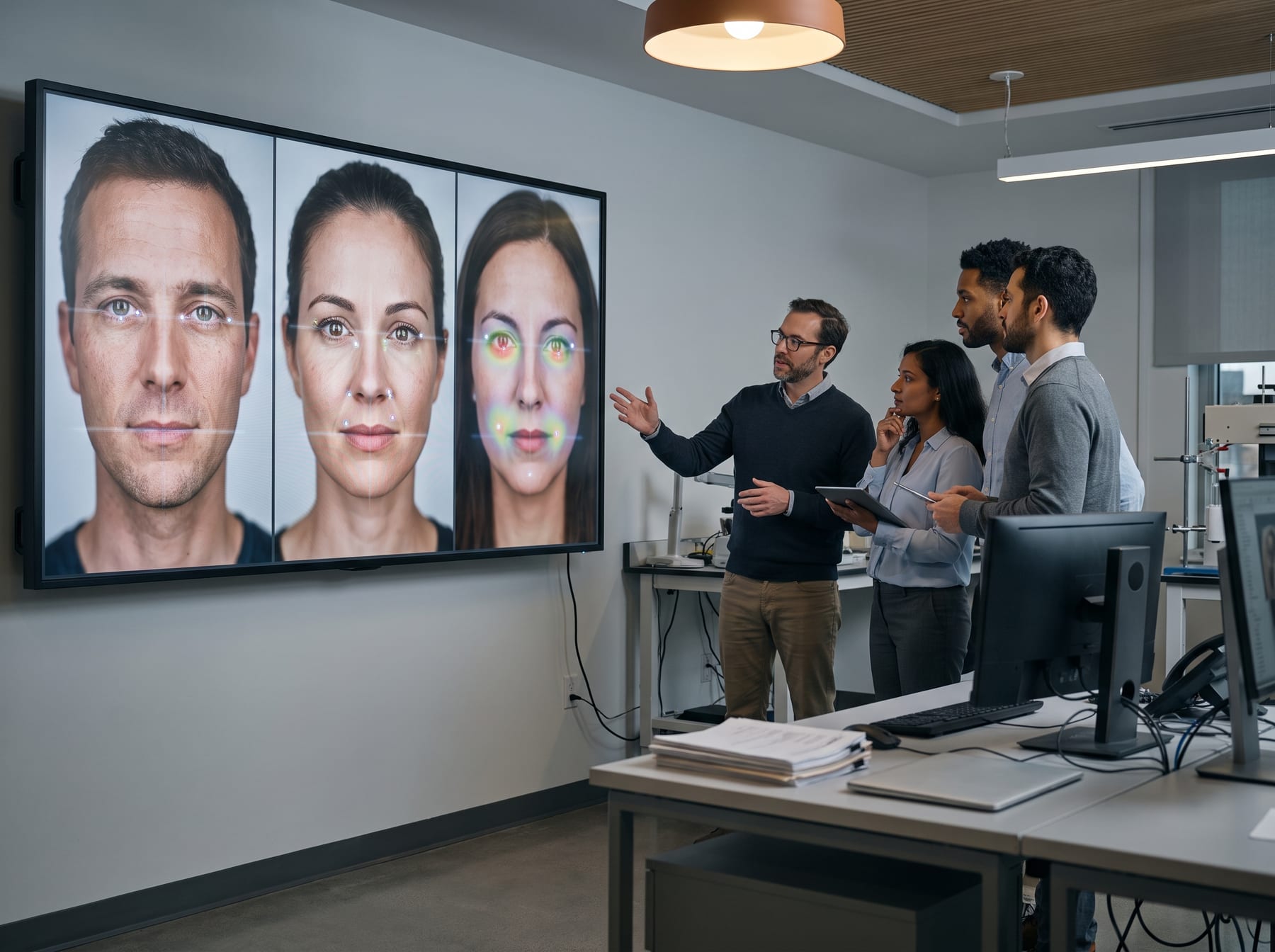
According to the researchers, the way to do that is to shift focus away from details and toward the broader picture—what they call global impressions. Specifically, they claim it’s best to focus on six key characteristics: symmetry, proportionality, attractiveness, expressiveness, distinctiveness, and memorability.
Generative AI doesn’t create images out of thin air. These tools are trained on massive troves of data that shape what they produce. When AI image generators create a picture of a face, the study says they rely on “the mathematical average of the tens of thousands of faces on which they are trained.” As a result, this reliance on the mathematical average can make a face seem “more typical in appearance than real human faces.”
According to the study, people appear to have an intuitive, unconscious sensitivity to broad facial differences between real and AI-generated images, even if they do not reliably translate that awareness into accurate deepfake detection.
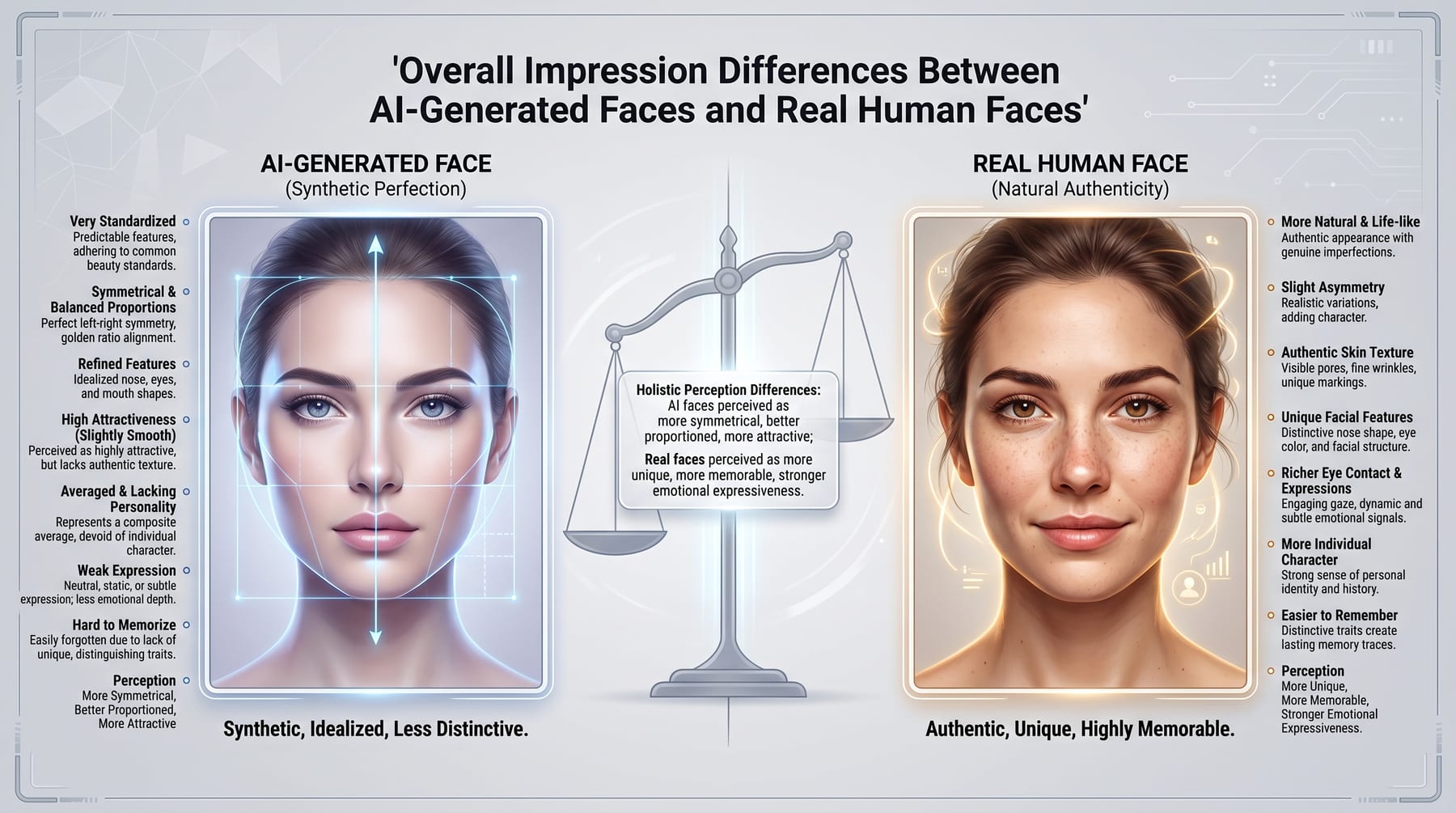
“People automatically detect these differences, rating AI faces as more symmetrical, well-proportioned, and attractive than human faces, but less distinctive, memorable, and expressive,” the researchers write.
This sensitivity can be used to train people to better identify AI deepfakes, the researchers claim. But the key isn’t just telling people to look out for symmetry or memorability; it’s training them to figure this out on their own, which is what the researchers sought to do in the study.
In the first phase of the study, the researchers showed a series of faces (some belonging to real humans and others AI-generated) to 45 participants and asked them to determine whether each one was AI-generated.
Then, instead of telling participants to look out for these six qualities, the researchers trained them via six training blocks, each consisting of 96 tasks. For each task, participants were shown images of human faces and told whether each one was real or AI-generated. They were then asked to rate each face based on a set of broad visual qualities. For example, participants judged how attractive or symmetrical they thought each face appeared. On average, participants ranked AI faces higher on symmetry, proportionality, and attractiveness, while human faces were deemed more expressive, distinct, and memorable.
After training was finished, the researchers had participants go back to determining whether each face was AI-generated. This time, the participants’ average accuracy had “nearly doubled,” with the highest-performing candidates even achieving “near-perfect accuracy,” the study claims.
“We speculate that, by directing attention to global impressions, our training enabled participants to become attuned to how these holistic qualities distinguish AI from human faces,” the researchers write.
The researchers say the training method is quick and easy enough to complete online that it can be successfully deployed to more people, though it is likely unrealistic to expect it to be scaled universally. The results of the study are also limited to AI image generators, so the jury’s still out on whether the training could successfully translate to the detection of audio or video deepfakes.