
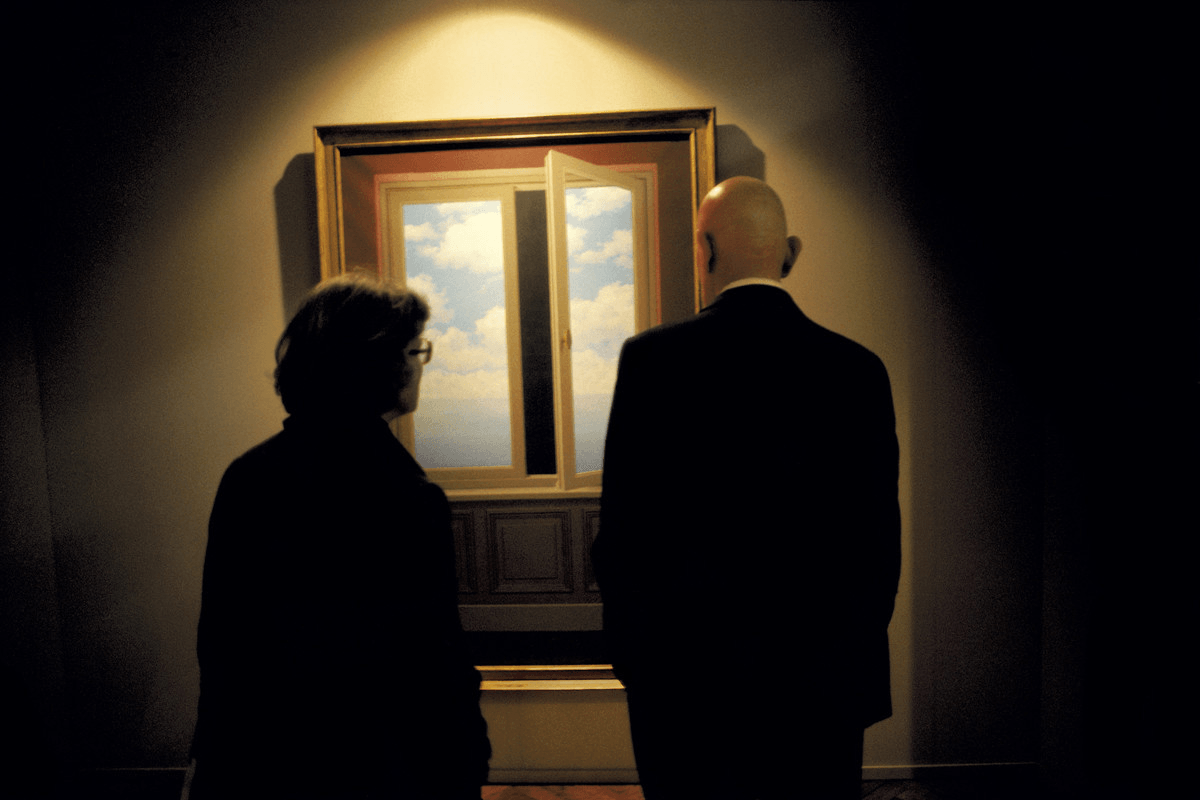
One afternoon in the 1970s, Harry Gruyaert walked into the Palais des Beaux-Arts in Brussels to see a Magritte exhibition. At the door, someone stopped him: no photographs allowed. He checked his camera at the cloakroom and stepped into the first gallery empty-handed.
There he came upon a bald man—striking, almost imposing—standing, of all places, before a painting of a bald man in a bowler hat. Something clicked: the figure in the painting and the figure before it seemed to mirror each other. Furious to be without his camera, Gruyaert rushed back to the cloakroom, only to discover he had lost his ticket. It took ten minutes of arguing to get the camera back.
He hid it under his jacket, slipped in through another entrance, and chased the man through room after room. At last, in the final gallery, he caught up. The man now stood beside a woman; together they gazed at a painting on the wall: a window of blue sky and white clouds, one shutter swung inward—revealing not the sky beyond, but a patch of total black, a void. It was Magritte’s La Lunette d’approche (1963).
In the darkened hall, a single spotlight fell on the painting. The blue sky became the only color in the room, while the two backs turned to the camera and the surrounding walls sank into warm brown shadow. Gruyaert pressed the shutter three or four times. He never spoke to the people he photographed.
Years later, his solo show Made in Belgium happened to open in that same museum. The curators wanted this photograph for the poster and went to seek permission from Magritte’s widow, who was still living. She loved it—she even thought the woman in the frame might be a younger version of herself. (It almost certainly was not.) The poster was printed. As for who the bald man was, Gruyaert never knew.
Then, a few months later, a phone rang from Brussels. “I am the bald man in your photograph.” A curious request followed: “This weekend I want to bring the most beautiful girl in the world to Paris. Would you take a picture of her?” Gruyaert declined—he said he was a street photographer, not a portraitist. The man hung up.
Thirty years passed. Another call came from Brussels, this time from a woman. The man in the photograph, she said, had died; he had been her father’s closest friend, and her father was about to turn ninety-five. She wanted to buy the photograph as a gift for him. So Gruyaert told her the story of that old phone call—how the man had once wanted to bring “the most beautiful girl in the world” to Paris.
There was a long silence on the line.
“That must have been me,” she said at last. “But I am no longer beautiful.”
There was a sorrow in her voice beyond words. She never called again. Gruyaert said he would gladly have given her the photograph for nothing.
And so the picture became a work that is still growing. No one can say whether Magritte’s painted window is real or illusion; and the lives beyond the frame—the real and the imagined, identity and time—fold into one another in much the same way. A man, photographed only once in his life, serving as the mirror of a painting; a woman, once “the most beautiful in the world,” reduced thirty years later to a quiet exit on the other end of a phone line. Two turned backs, one window opening onto the void—here, the act of looking itself becomes a parable of the real and the imagined.