
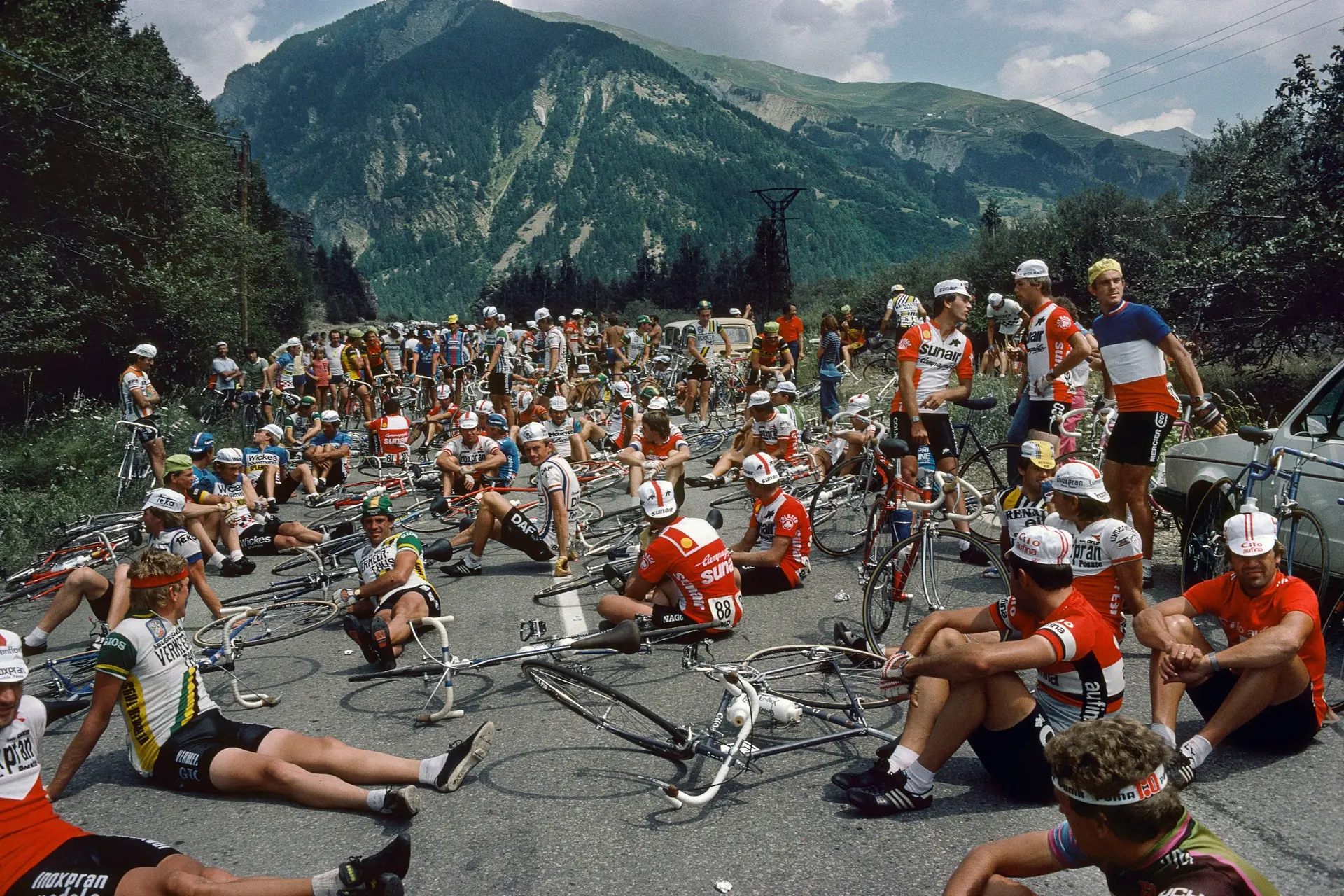
The most iconic scene of the 1982 Tour de France wasn’t a sprint to victory—it was a mass halt. Farmers blocked the road with tractors, leaving elite riders to sit on an alpine highway, zoning out, napping, and chatting. Master photographer Harry Gruyaert pressed the shutter: no speed, no victory—only waiting. Why did this “non-decisive moment” become the most unforgettable image in Tour de France history?
This classic color photograph, taken by Belgian photographer Harry Gruyaert for Magnum Photos, documents the farmers’ protest on Stage 16 of the 1982 Tour de France (the 69th edition). In the frame, a large group of professional riders and their bicycles are stopped on an alpine mountain road. The scene looks chaotic, but it is not a crash: it is the moment when protesting farmers blocked the route with tractors, interrupting the race and forcing the riders to sit on the tarmac and wait for the competition to resume.
Stage 16 of the 1982 Tour started in Orcières (Orcières-Merlette) and finished on the legendary climb of l’Alpe d’Huez. It covered about 123 kilometers on 20 July 1982, with roughly 3,000 meters of total elevation gain. Shortly after the stage began, angry farmers blocked the road with tractors to protest the Common Market’s price controls on agricultural goods. Race organizers negotiated with the farmers and cleared the route, causing a delay. After the interruption, the riders were allowed to continue; the stage was ultimately won by Beat Breu, while the overall victory went to Bernard Hinault—his fourth Tour de France title. The photograph captures this stretch of waiting time opened up by the protest. Magnum also preserved a related image from the same scene: Belgian rider Ludo Peeters using the delay to catch some sleep by the roadside—evidence that this was not a fleeting instant, but a pause long enough to be photographed at leisure.
In the image, riders are scattered across the road, seated with bicycles laid beside them, forming an almost “battlefield rest” kind of temporary order. Behind them is the alpine landscape that matches Stage 16’s mountain route. The riders’ clothing, helmets, frames, and team kits carry the distinct look of 1980s professional road racing, and visual elements of teams such as La Vie Claire and Sunair can be identified, further confirming the era. Crucially, this is not a moment of crash or sprint, but a collective state of prolonged waiting: relaxed postures, some riders talking, others simply gazing about, with the competitive order of the peloton momentarily suspended.
The photographic value of the image rests on its grasp of the “non-decisive moment.” It does not present victory, speed, or the podium; instead, it focuses on pause, fatigue, waiting, and institutional interruption—shifting the professional rider from a “racing machine” back into an ordinary person who tires and is forced to stop. In this way, sports photography expands into social documentary: the Tour becomes not only a competition, but a social scene where the French countryside, a farmers’ protest, public roads, and professional sport intertwine. Gruyaert is celebrated for color photography; unlike the largely black-and-white news reportage of the time, he used the colors of team kits, advertising, bicycle frames, and mountain roads to build a visual archive of 1980s European road racing. The frame has almost no single protagonist: people, vehicles, bicycles, and mountains are scattered together, forming a temporary social landscape composed of athletes and their environment.
To understand this photograph, it helps to return to the photographer. Harry Gruyaert was born in 1941 in Antwerp, Belgium, studied film and photography in Brussels from 1959 to 1962, won the Kodak Prize in 1976, and became a Magnum member in 1982. Both Magnum and the Deutsche Börse Photography Foundation emphasize that Gruyaert excels at organizing color, form, light, and movement into a whole; his work does not always privilege narrative, but instead finds a near-painterly visual magic within everyday elements. This approach aligns closely with the character of *Farmers’ revolt, 1982*: the image relies not on a single “hero” or dramatic climax, but on a temporary social scene built from riders, road, bicycles, mountains, and blocks of color.
References
- The New Yorker — *Seventy-Five Years of Cycling*
- Bicycling — *Best Tour de France Photos*:
- Magnum Photos — *Tour de France: Inside the Peloton*