
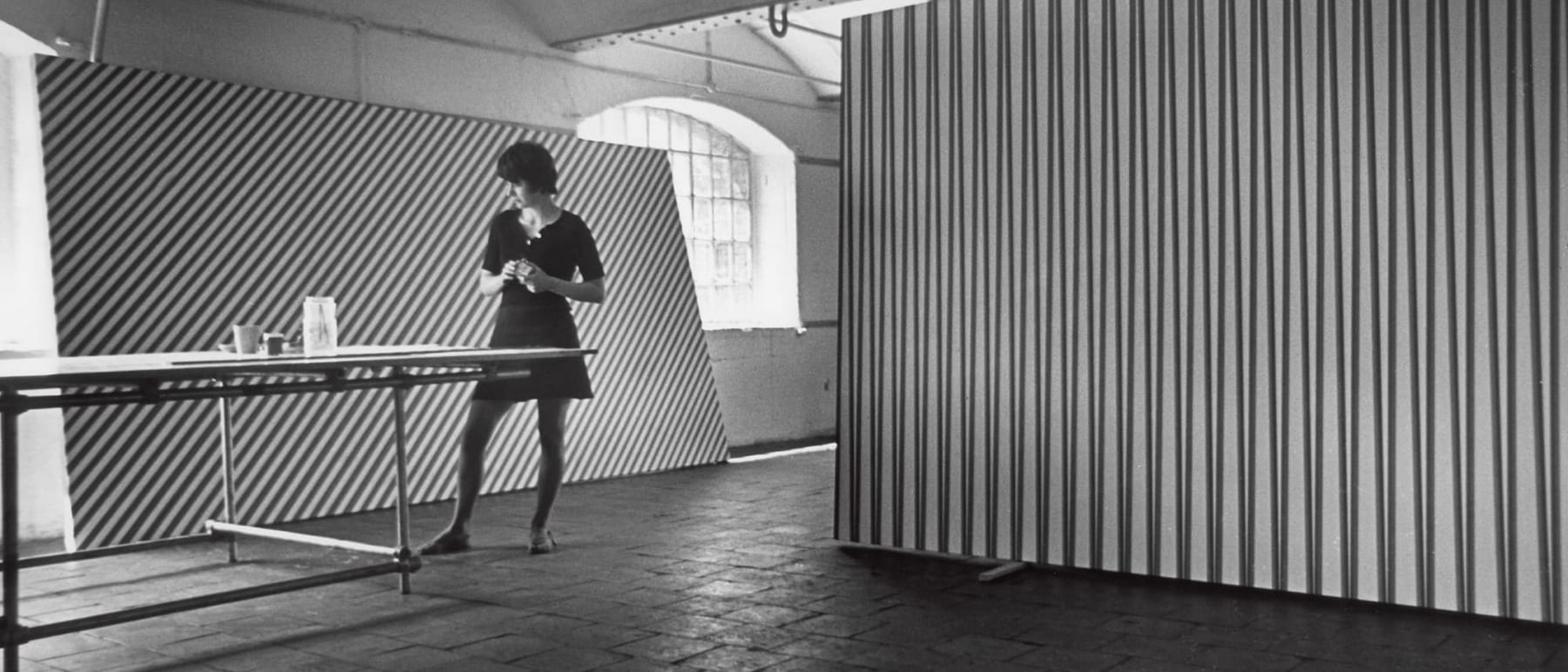
Riley in her Space Studio with Byzantium and Rise 1, 1969. Jorge Lewinksi. © The Lewinksi Archive at Chatsworth/Bridgeman Images.
A black-and-white revolution
Op Art pioneer Bridget Riley first developed her revolutionary approach to painting not in the vivid colors that later seem to surge and retreat before our eyes, but in simple, uniform black and white. As a new exhibition at Dia Beacon featuring six of her key works from the 1960s makes clear, it was by reducing her palette to its essentials that she first achieved the dazzling optical effects that have defined her career for more than 60 years. In these early paintings, the distance between lines, the tilt of an angle, and even the slightest compression can produce entirely different bodily and perceptual responses.
Four experiments in perception
In the fiercely visceral Burn (1964), for instance, an intricate grid of subtly shifting black-and-white triangles is interrupted by a white, V-shaped blur in the lower half of the painting. The result is an image that, while ostensibly static, seems to flicker with the intensity of flames.
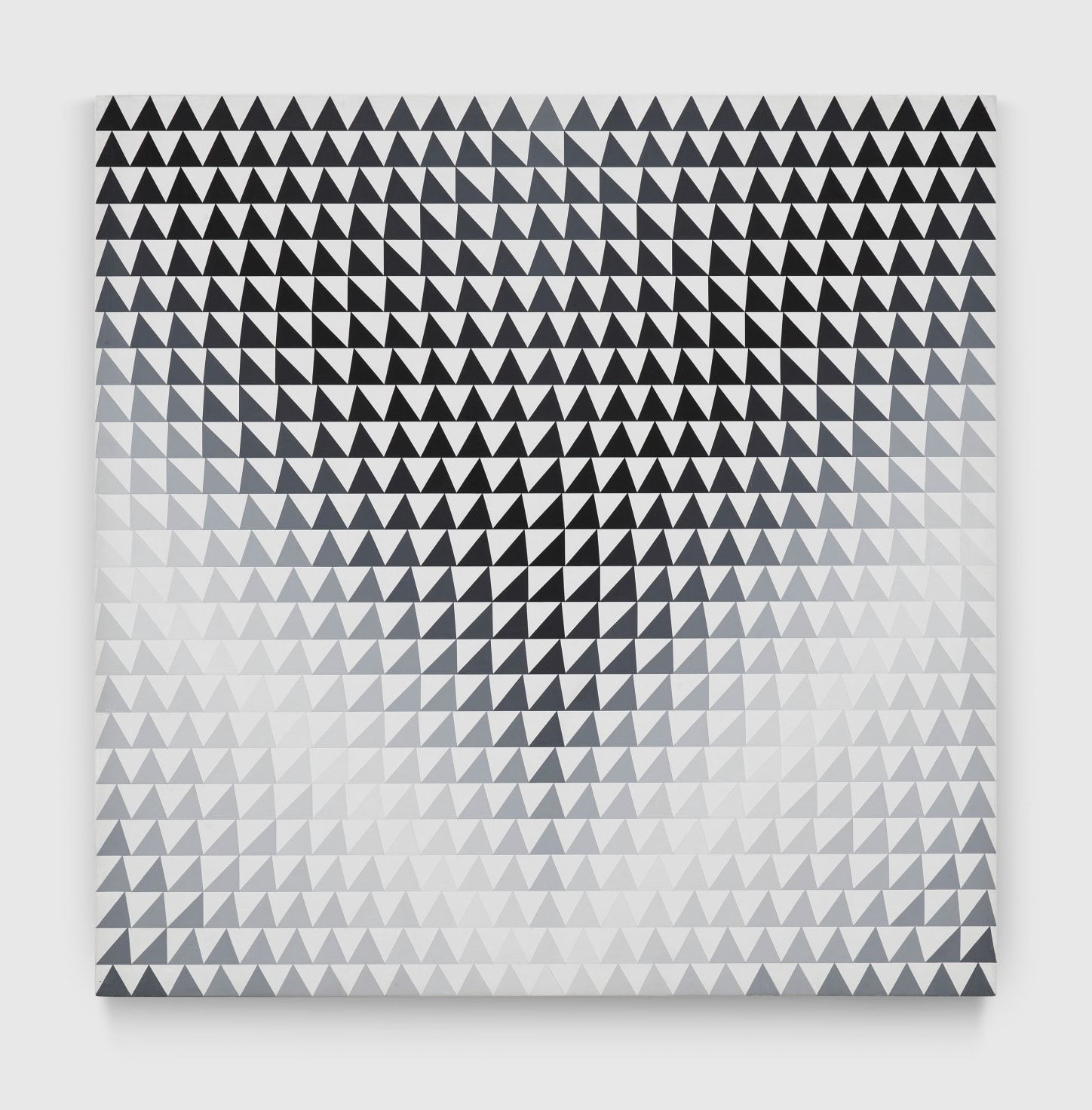
Bridget Riley, Burn, 1964. © 2026 Bridget Riley. All rights reserved. Courtesy the artist and David Zwirner. Photo by Jack Hems.
In Interrupted Circle (1963), part of Riley’s ‘disfigured circle’ series, the artist plays with the illusion of sections of the circle shifting outward, as if being pulled into another dimension.
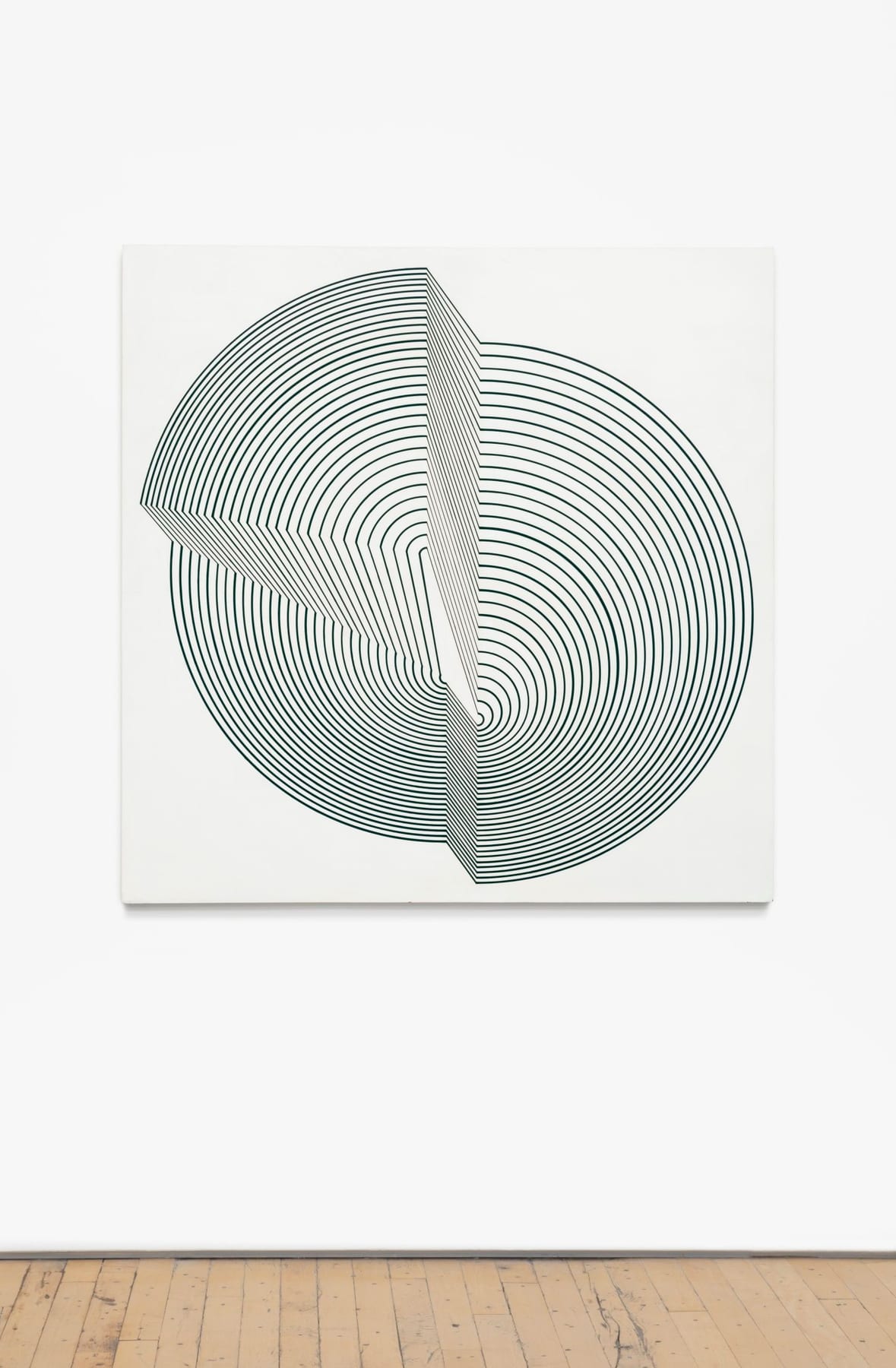
Bridget Riley, Interrupted Circle, 1963. Dia Art Foundation. Gift of Louise and Leonard Riggio. © Bridget Riley. Photo by Bill Jacobson Studio, New York.
She went a step further with Climax (1963), giving the canvas itself lyrical curves. (It’s one of only three shaped works Riley made, all between 1963 and 1964.)
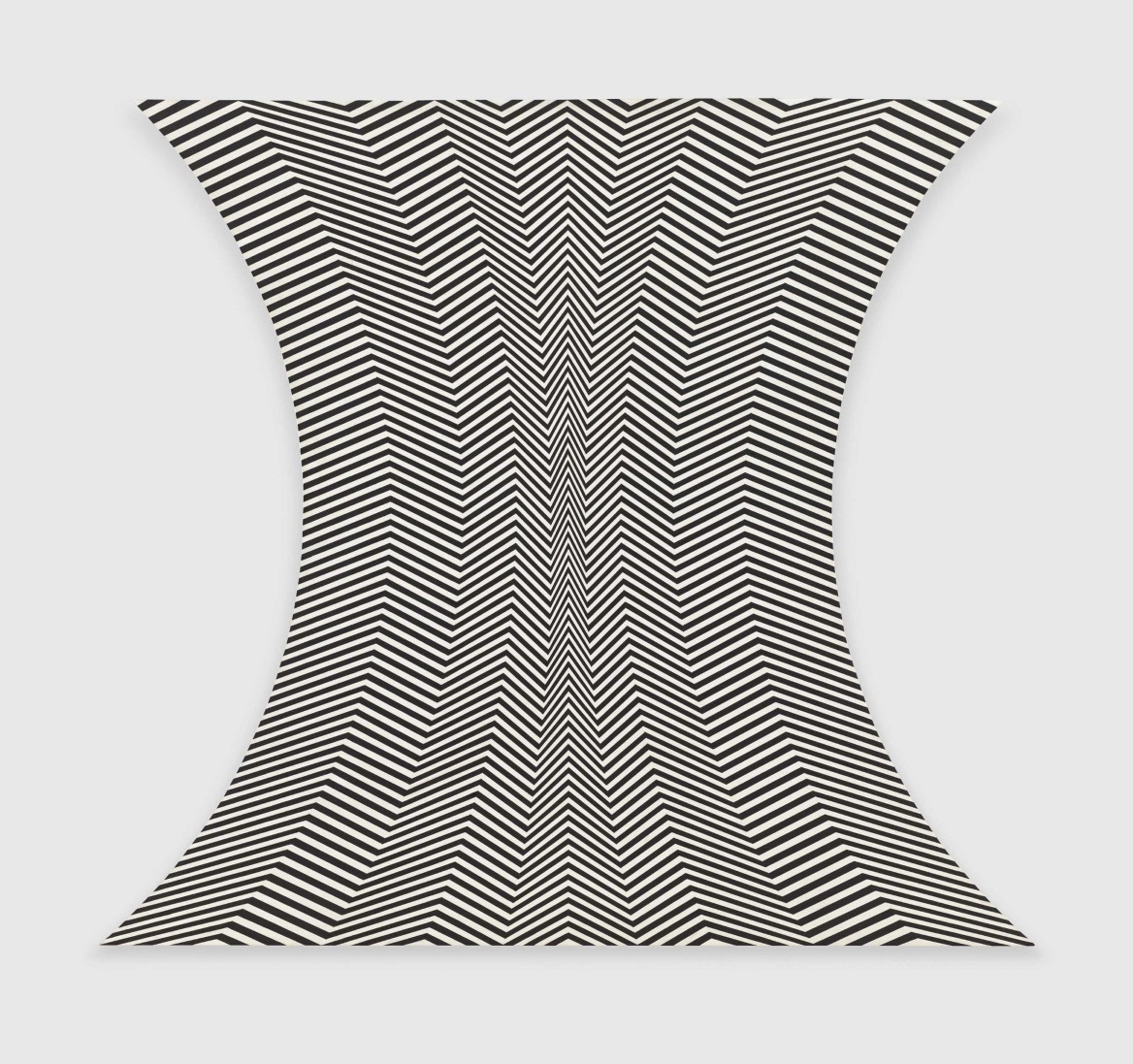
Bridget Riley, Climax, 1963. © 2026 Bridget Riley. All rights reserved. Courtesy the artist and David Zwirner. Photo by Anna Arca.
In Serif (1964), undulating lines tilt the canvas away from its familiar orientation, so it points upward like a diamond. The effect is like peering through a porthole and catching a landscape speeding by.
Tuscany, Seurat, and “a most useful failure”
The works’ genesis might seem at odds with the lyricism of Riley’s early palette. On a summer’s day in 1960, the 29-year-old painter was driving through the hills of Tuscany with the artist and writer Maurice de Sausmarez. Having studied at Goldsmiths and the Royal College of Art in the early 1950s, she was working as a graphic designer at the advertising agency J. Walter Thompson when she met de Sausmarez at the summer school he ran. This early mentor, who opened her eyes to the significance of the Post-Impressionists, became her lover. Suddenly, thunder clouds rolled in and the landscape shimmered in the heat. Fascinated, Riley made numerous sketches.
Back in her London studio, she painted Pink Landscape (1960), a square, violet‑pink‑and‑blue pointillist work clearly in thrall to her hero, Georges Seurat. The previous year, she had recreated his Bridge at Courbevoie (1886-1887), a process that helped her understand how juxtaposing separate colors can change perception. Yet, despite the painting’s condensed beauty, Riley was dissatisfied with her inability to capture what she had witnessed on that hot Tuscan day. When I visited her in her London studio eight years ago, she dismissed the painting as ‘a most useful failure.’ That, she suggested, was not necessarily a bad thing. In her 1996 essay ‘Painting Now’, Riley explained: ‘Painting without its problems can no longer be painting. It depends upon them for its existence.’
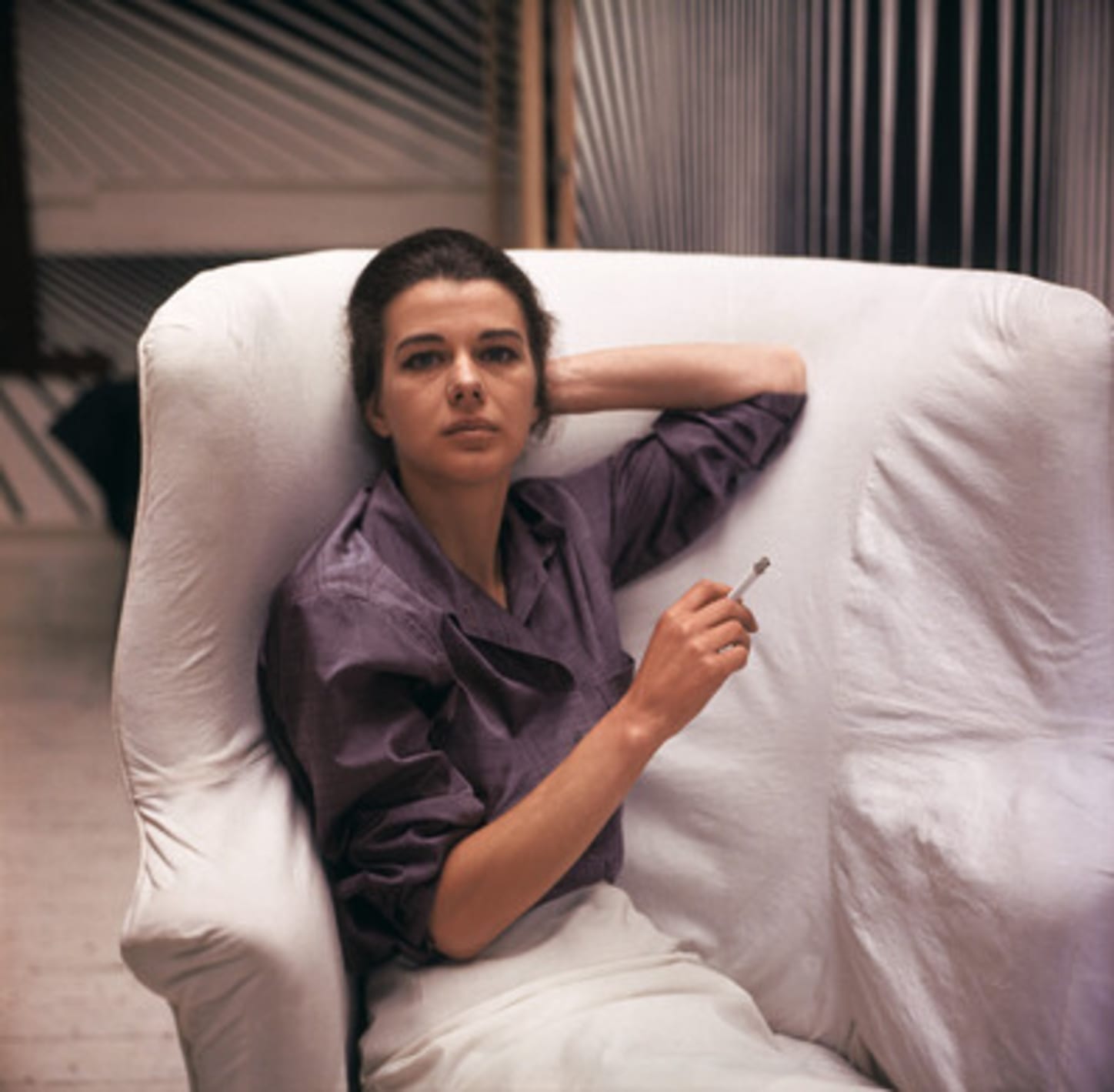
Warwick Road Studio, 1963. © Snowdon/Trunk archive.
Art history, popular culture, and nature
Riley has always been clear that, to understand the language of art, you must first dive into its history, and her many essays offer a clear insight into her thinking. While her work is emblematic of 1960s visual culture, made famous by reproductions of its ‘trippy’ effects on t-shirts or Biba dresses, this dilution in popular culture infuriated her. After her breakout inclusion in ‘The Responsive Eye’ at MoMA, New York, in 1965, she was outraged, on the drive to the airport, to see her paintings reproduced without permission on the dresses that filled Madison Avenue’s shop windows.
In fact, she was first drawn to Geometric Abstraction because of its mythic familiarity: squares, triangles, and rectangles are ancient forms whose function is both versatile and universal. Like Paul Cézanne, too, she has long been indebted to the lessons—both visual and conceptual—that she draws from the landscape. In 1973, in ‘Working with Nature’, she wrote: ‘I draw from nature, I work with nature, although in completely new terms.’
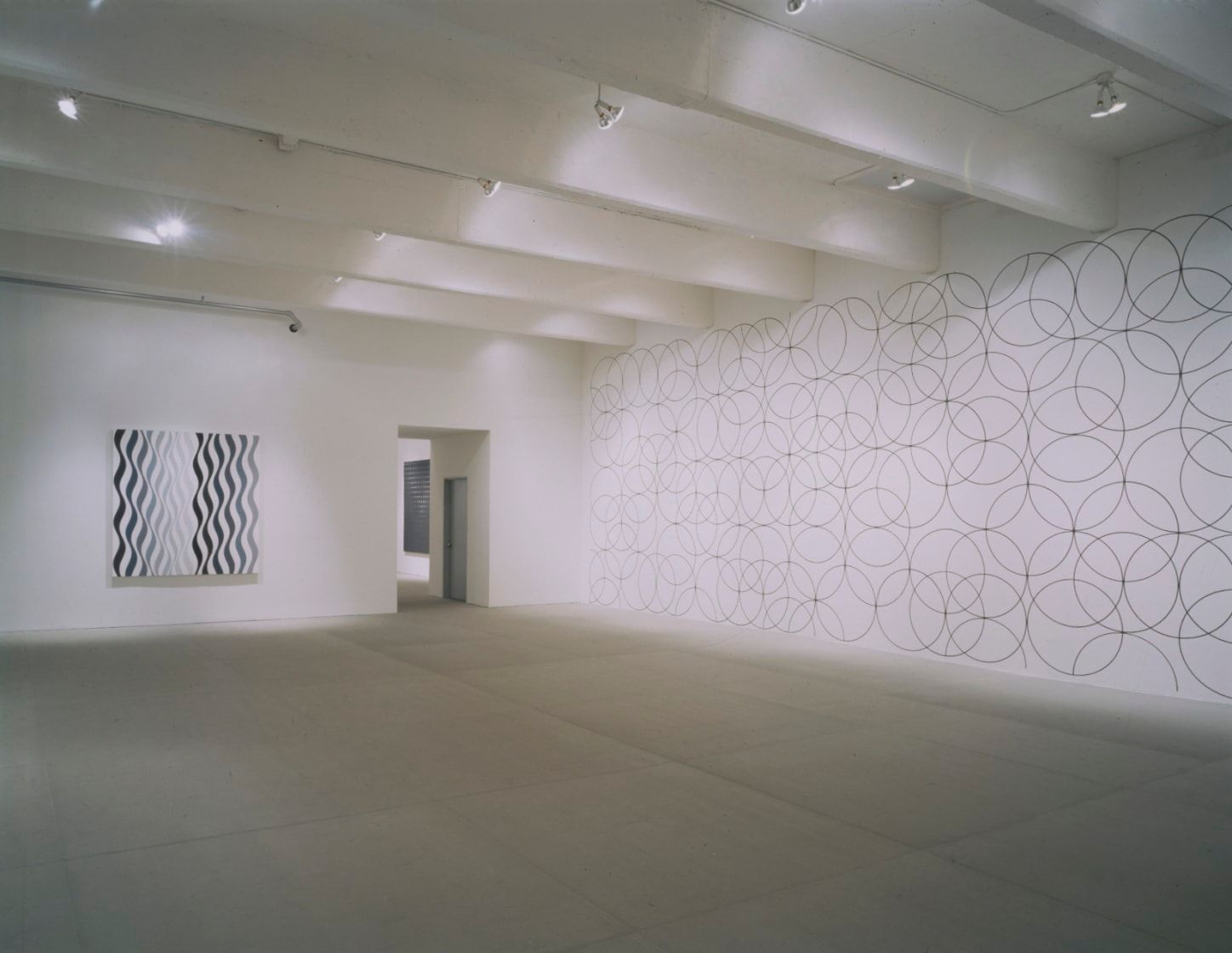
Bridget Riley, Reconnaissance installation view. Photo by Bill Jacobson.
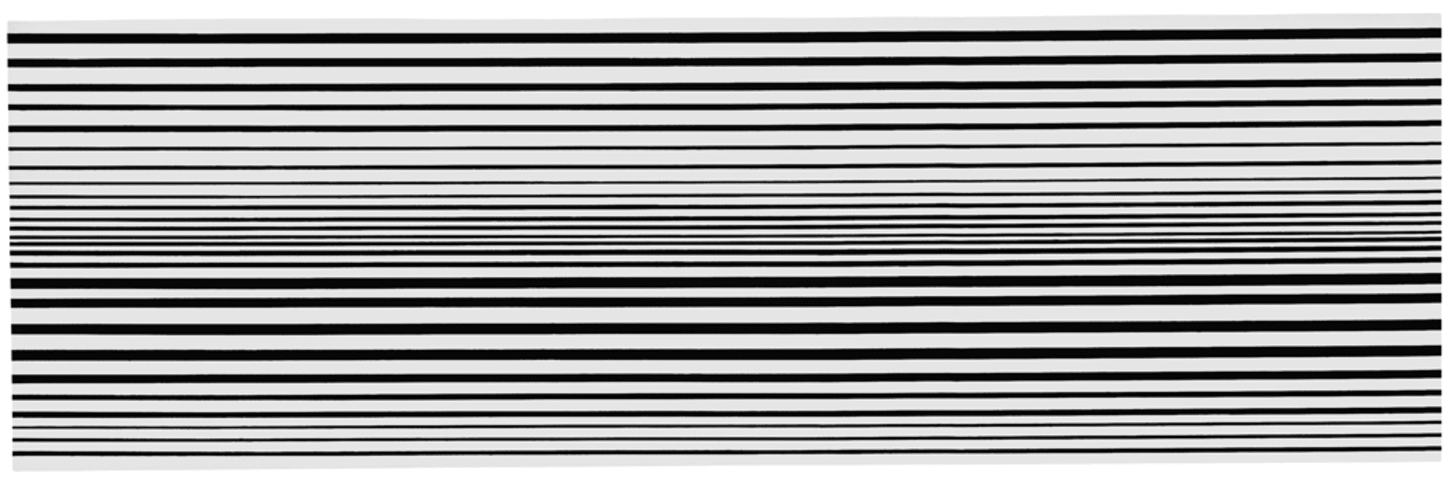
Bridget Riley, Horizontal Vibrations, 1961. © Bridget Riley 2026. All rights reserved. Courtesy the artist and David Zwirner.
Perception as an optical and emotional experience
Riley’s experiments—a fusion of optical and emotional exploration—produced a visual language that is essentially ambiguous, despite its hard-edged clarity. She has written that painting is an act of translating “a text unknown even to yourself.” Repeating a motif, then, is not a sign of reduction or detachment, but the opposite. In her 1965 essay “Perception is the Medium,” written while she was making her black-and-white works, she suggests that “repetition, contrast, calculated reversal and counterpoint also parallel the basis of our emotional structure.”
In interviews, Riley often reiterates that looking engages all the senses. In 1967, the art historian David Sylvester asked what the experience of looking at her paintings was comparable to. She replied: “Running…early morning…cold water…fresh things, slightly astringent…things like this…certain acid sort of smells.” For Bridget Riley, life is not outside the picture frame; it inhabits it.
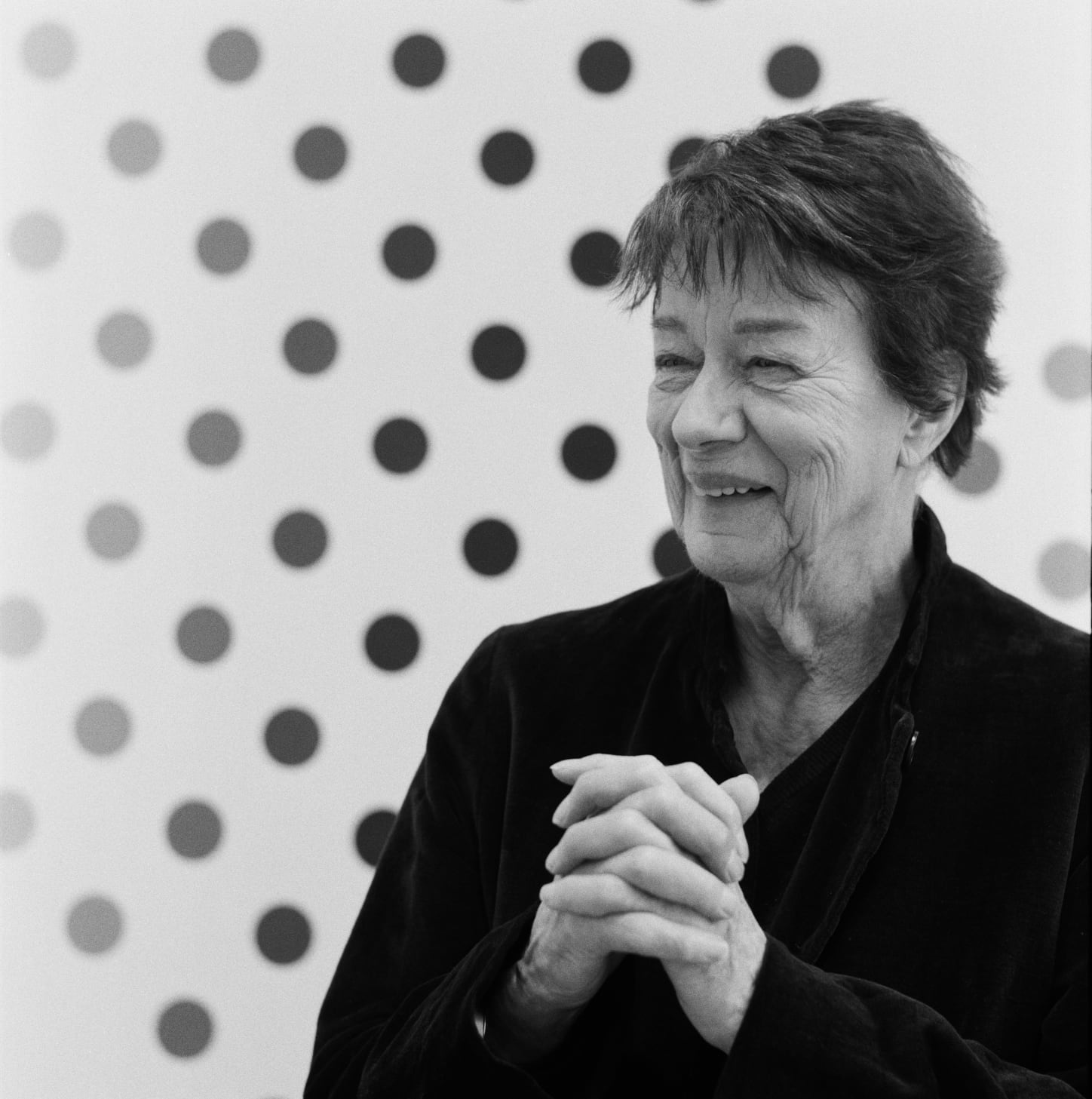
Bridget Riley, 2018. Photo by Johnnie Shand Kydd. © Bridget Riley. Courtesy the artist and David Zwirner.
Exhibition and credits
- Bridget Riley is represented by David Zwirner (Hong Kong, London, Los Angeles, New York, Paris).
- ‘Bridget Riley’, Dia Beacon, Beacon, New York, on view until July 2028.
- Jennifer Higgie is an Australian writer who lives in London. Her novel Bedlam, about the Victorian fairy painter is published by Verso.
- Published on July 16, 2026.
- Author: Jennifer Higgie
- Source: Art Basel