
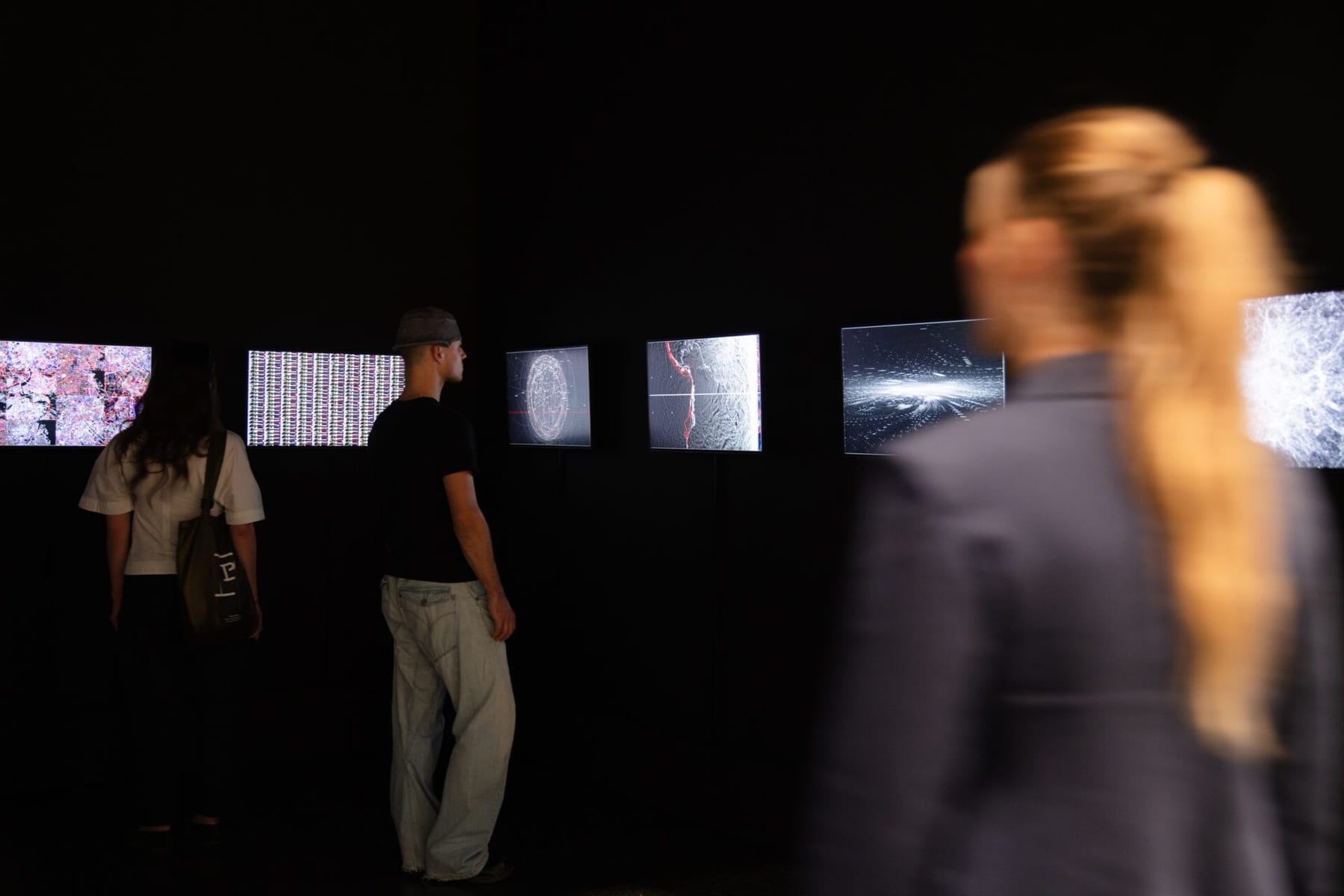
Featured Photo: Zero 10. Image Courtesy by Art Basel.
As artificial intelligence reshapes public debates around images, authorship, and cultural production, Trevor Paglen‘s ideas have taken on renewed urgency. Bringing together a decade of essays, his new book How to See Like a Machine argues that today’s AI systems are part of a much longer history of machine vision, surveillance, and computational ways of seeing. At the same time, Paglen recently co-curated Zero 10 at Art Basel, making the case that digital art belongs within the broader history of contemporary art rather than at its margins.
In conversation with Anika Meier for SLEEK, Paglen reflects on the changing status of digital art, the role of curation as a form of storytelling, and why art continues to operate according to different logics than the algorithmic systems that increasingly shape everyday life.
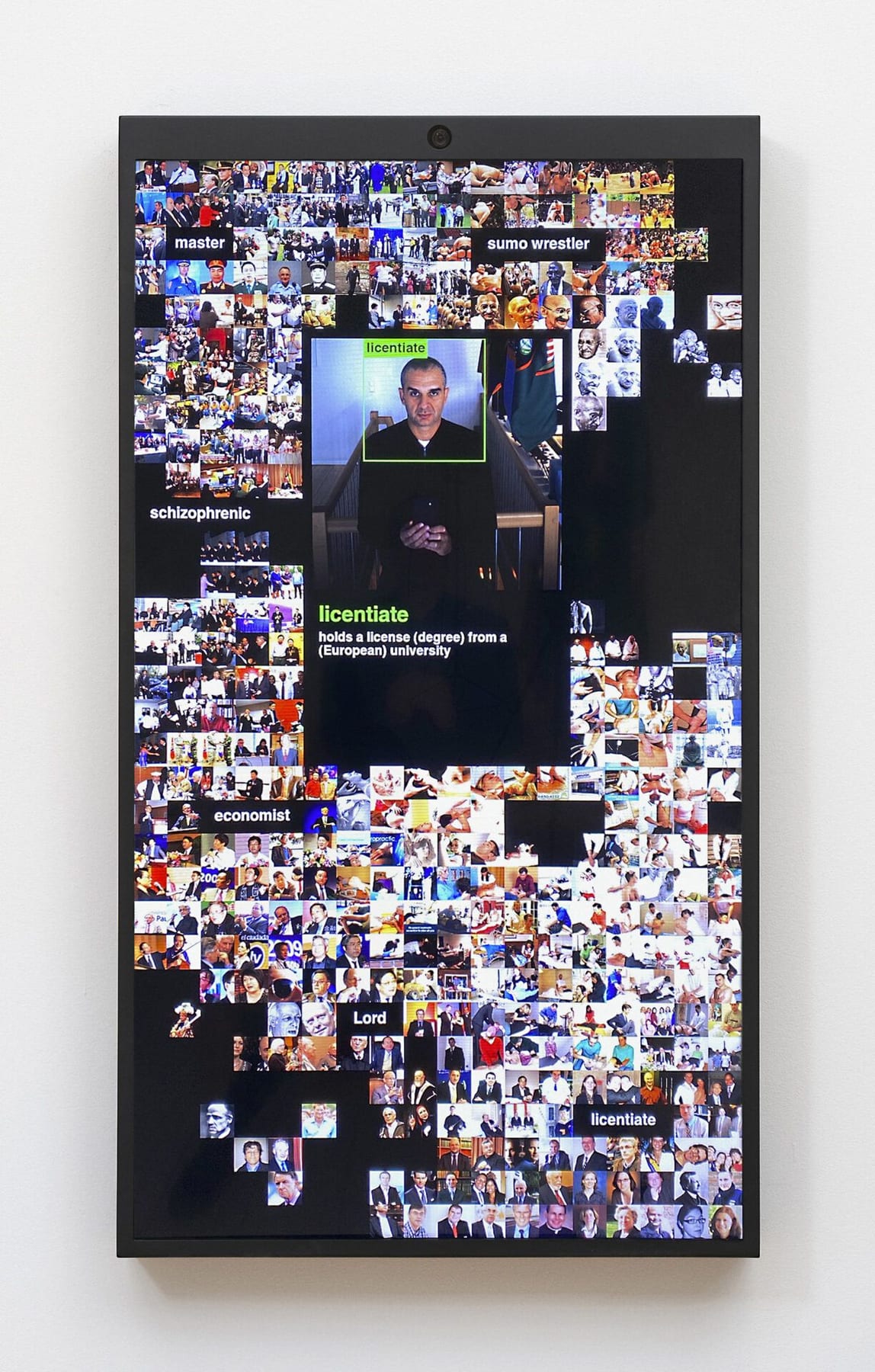
Faces of ImageNet, 2022 Interactive video installation Dimensions variable Copyright Trevor Paglen Courtesy of The Artist and Fellowship and Jessica Silverman, San Francisco and Pace Gallery, New York.
Revisiting the essays gathered in his just-published book How to See Like a Machine, written over a decade in which AI became a dominant cultural preoccupation, Paglen was struck by how well they held up.
It was remarkable to see that it all still worked. I was actually surprised because I hadn’t reread some of the older essays until I started putting the book together. When I did, I realized that while some of the examples had become dated, the ideas still felt relevant. I was surprised by how naturally the essays formed an arc from the past to the present, and by how well they still held together.
Having written about machine vision and operational images for over a decade, he attributes their reaching a broader audience only now to the ubiquity of AI.
AI has simply become much more ubiquitous. People are much more aware of it, and much more concerned about it. It’s become much more present in everyday life, whether in the workplace, at home, or through social media and the technologies our kids use. So I think the book is coming at the right time because it’s been thinking through these questions over a much longer period. When some of the essays were first published, AI wasn’t part of everyday life in the way it is now.
On Zero 10, the digital-art initiative he recently co-curated at Art Basel — an art fair, and thus an inevitably commercial setting — he confirms the project makes a serious curatorial argument for digital art as part of the history of contemporary art.
I don’t think that’s taking it too far. The argument of the exhibition is that most art today is digital art. We’ve just been reluctant to name it as such. Gallerists, curators, and institutions have tended to keep “digital art” as a separate category, probably because in the late 1990s and early 2000s it was associated with places like Ars Electronica, which existed outside the mainstream contemporary art world. Our argument is that if you look at what artists are actually doing, almost every artist is making digital work in one way or another.
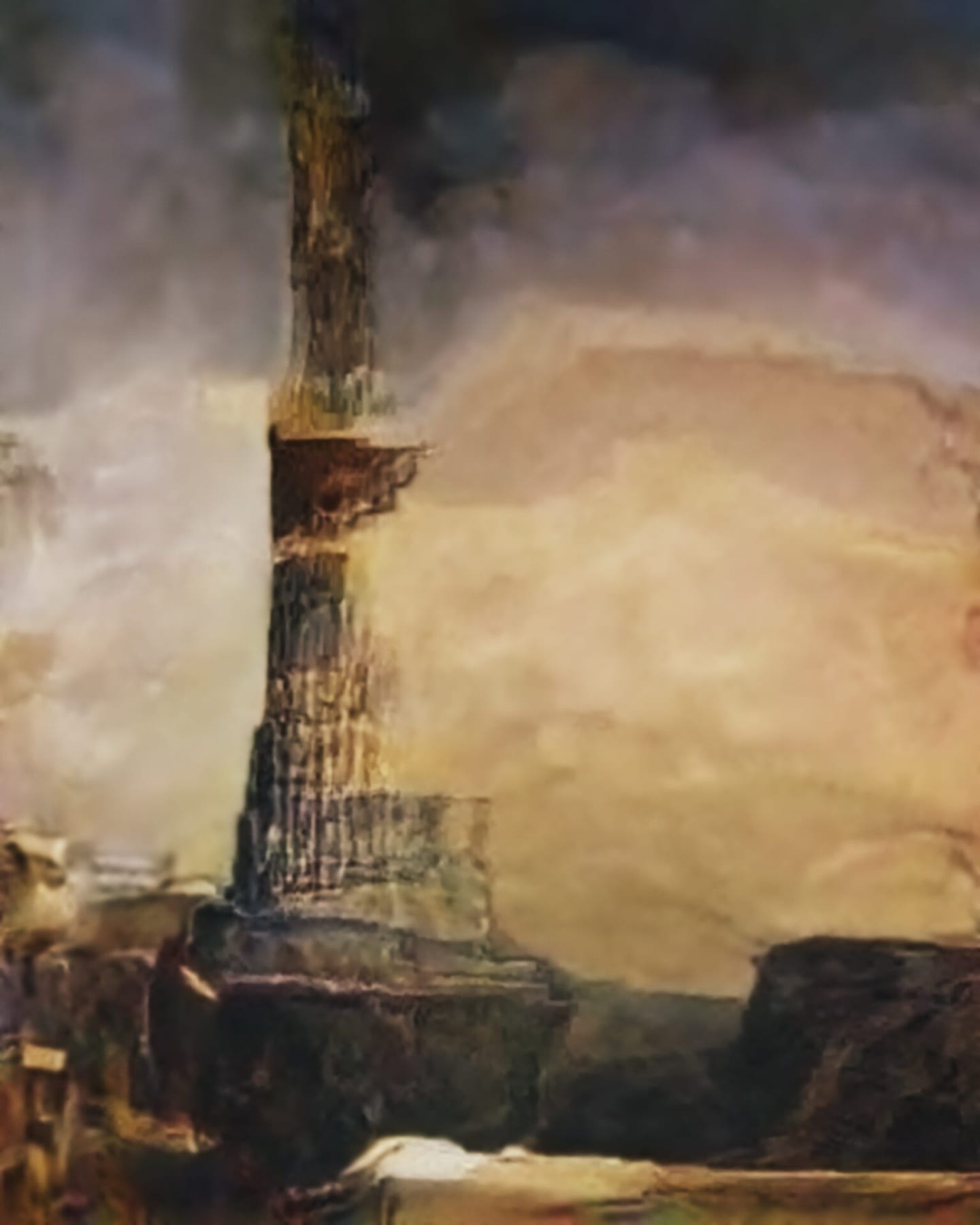
The Tower of Babel (Corpus: Spheres of Purgatory) Adversarially Evolved Hallucination, 2017 Dye sublimation on aluminum print 60 × 48 in. Copyright Trevor Paglen Courtesy of The Artist and Jessica Silverman, San Francisco and Pace Gallery, New York.
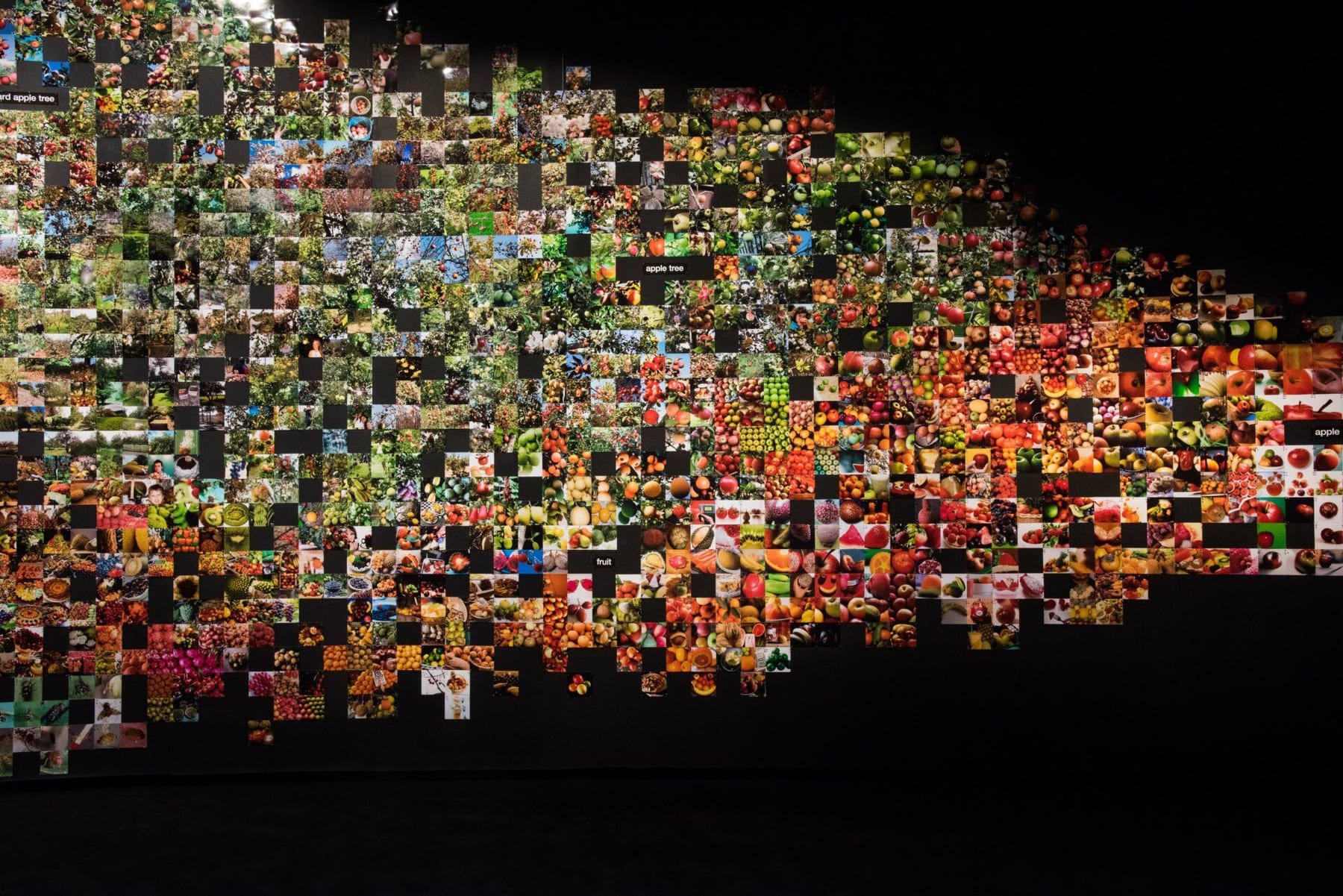
From ‘Apple’ to ‘Anomaly’ (Pictures and Labels) Selections from the ImageNet dataset for object recognition, 2019 Photography, pins, labels Installation view, “From ‘Apple’ to ‘Anomaly’ (Pictures and Labels) - Selections from the ImageNet dataset for object recognition”, Barbican Centre - The Curve, London (September 2019 - February 2020) Photo by Max Colson Copyright Trevor Paglen Courtesy of the Artist and Barbican Centre - The Curve, London.
A divide persists over the label: in the contemporary art world, institutions, galleries, and collectors often avoid the term — collector Julia Stoschek calls it time-based media — while online communities embrace it. Represented by Pace yet working closely with Fellowship, Paglen reads the split as a matter of framing.
What’s going on is that people are trying to create different frameworks through which to view the work. That’s how I interpret it. You’re prompting your audience to look at a particular artist or artwork through a certain lens, and that’s fine. People have always done that. There’s nothing metaphysical about it. It’s really just a way of telling a story. Zero 10 in Basel was meant to show that people have been thinking about these questions and working in these ways for much longer than the NFT boom. None of this was invented during COVID. There’s a much longer, richer, and more interesting history of artists foregrounding digital tools in their practice.
For me, that history also includes systems thinking and cybernetics. I originally wanted to include some of Hans Haacke’s systems works, as well as works by Hanne Darboven. We weren’t able to secure those loans, but I wanted the exhibition to reflect that broader, almost cybernetic sensibility as well.
He rules out already having an institutional exhibition in mind.
No, definitely not. (laughs)
Asked whether the exhibition invites us to read artists like Andreas Gursky, Hito Steyerl, and Avery Singer within the history of digital art, even though they usually aren’t labeled that way, he is careful about the phrasing.
I wouldn’t put it that way. I wasn’t trying to label artists. I was talking about the concept for the exhibition. I hope it didn’t come across that crudely.
Pressed on whether, by his definition, they are digital artists, he concedes the point.
Sure, why not? They’ve all been making digital work.
If curating is a form of storytelling, the question is what that leaves for the artist — especially given Mat Dryhurst’s argument that the creators of protocols increasingly shape culture.
I still call myself an artist. Old school, I guess. (laughs) Mat Dryhurst is right to point out that protocols shape what becomes visible. Whatever the Instagram algorithm is doing will largely determine what kinds of work get seen and circulated. You could say museums are analogous in that sense. There are certain criteria a work has to meet in order to become legible within an institutional context. That said, I wouldn’t go as far as Mat Dryhurst does in arguing that the real artist is the person designing the attention algorithm. That’s certainly part of the story, and it’s an interesting thesis that’s worth taking seriously, but I don’t think it’s the whole story. Art is many things.
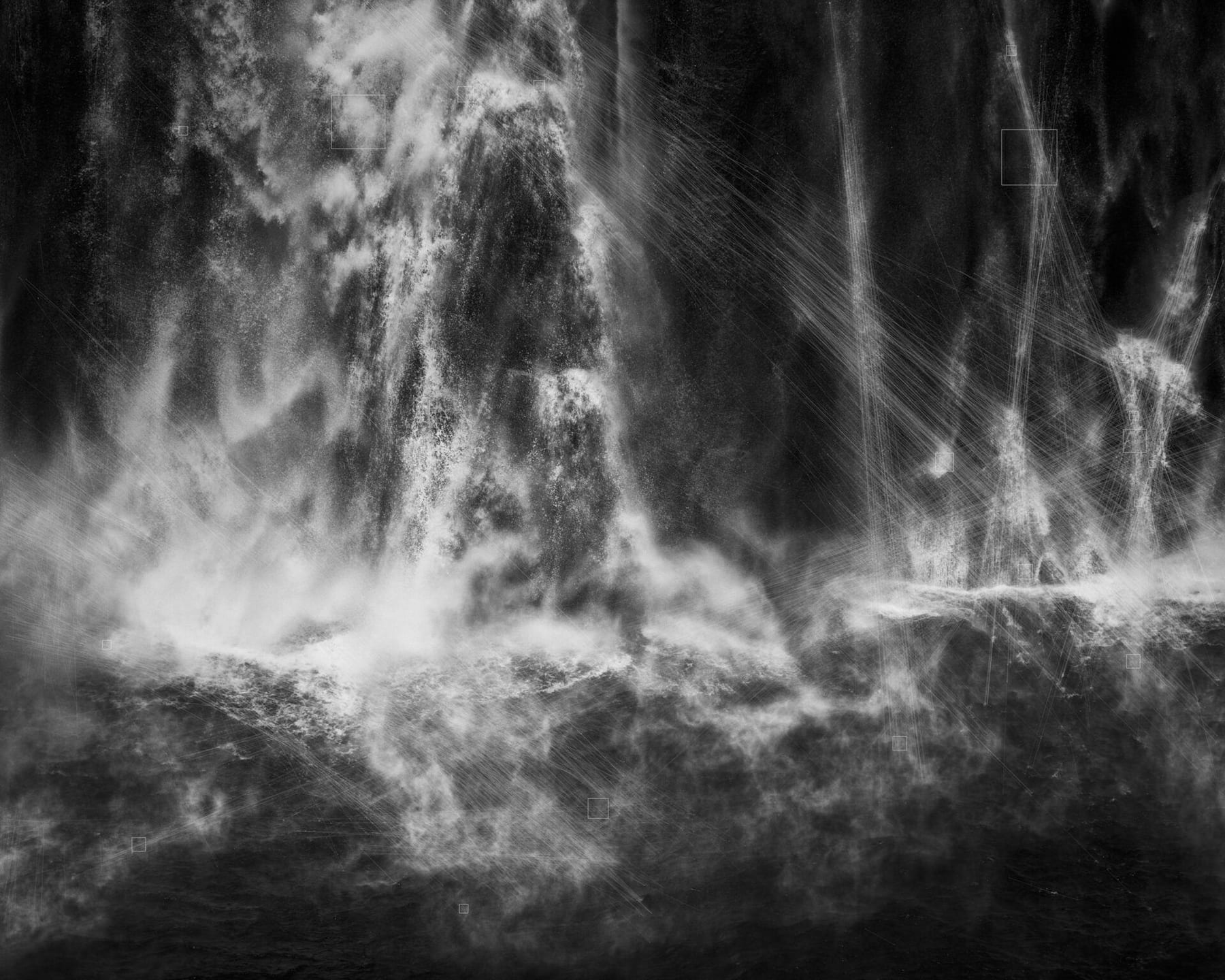
Shoshone Falls Hough Transform; Haar, 2017 Silver gelatin print 48 × 60 in. Copyright Trevor Paglen Courtesy of the Artist, Jessica Silverman, San Francisco and Pace Gallery.
In the book he argues that most images today are made for machines, seen by machines, and ranked by machines — which raises whether artists can still be visible without playing into the attention economy.
You can just make art for humans. No problem. I make a distinction between artworks and what we might call visual culture, or simply images. It’s true that the overwhelming majority of images in the world are made by machines for other machines, and that humans often have to do extra work just to see them. But I don’t think an Avery Singer painting, for example, is made for machines. It’s made for humans. It’s operating according to a different protocol. Artworks function differently from something like a facial recognition algorithm. They simply exist in the world differently.
Of course, you can make art that’s intended for machines, or art that’s made by machines for other machines. That’s perfectly possible. But art is a much more flexible category than that. You can take many different positions, address many different audiences, and work with very different assumptions. That’s what makes it exciting to me. As an artist, you don’t have to make work for the TikTok algorithm. You can if you want to, but you don’t have to.
That visibility still has to come from somewhere; if not from institutions, the question is whether it inevitably depends on how one behaves online.
Or from the gallery show you put together in your basement for your friends. There are many different ways to do it. It would be a very bad thing if all art had to pass through the choke point of the Instagram algorithm. Take Avery Singer’s work. If you see it on Instagram, that’s not really the work. The same is true for a lot of my own work. I get frustrated putting it online because it isn’t designed to be seen that way. It’s meant to be experienced in person and at scale. There are aspects of the work you simply can’t see online.
In the book he also writes about the “society of the psyop,” drawing on Guy Debord’s society of the spectacle, and explains how the two relate.
The move I’m trying to make is this: in The Society of the Spectacle, the basic model is that humans look at images, and those images mediate relationships between people. As Debord famously put it, the spectacle is “a social relation among people, mediated by images.” The “society of the psyop” modifies that model. You look at an image, but the image also looks back at you. You’re in a feedback loop with it. It’s constantly evolving in order to capture your attention or influence your behavior. It’s much more directed, much more active, and fundamentally recursive. And it all happens very quickly. That’s the key difference between the present moment and the society of the spectacle that Debord described.
The word “spectacle” recurs in an art world where exhibitions are increasingly expected to produce spectacular, shareable moments — something he deliberately resisted with Zero 10.
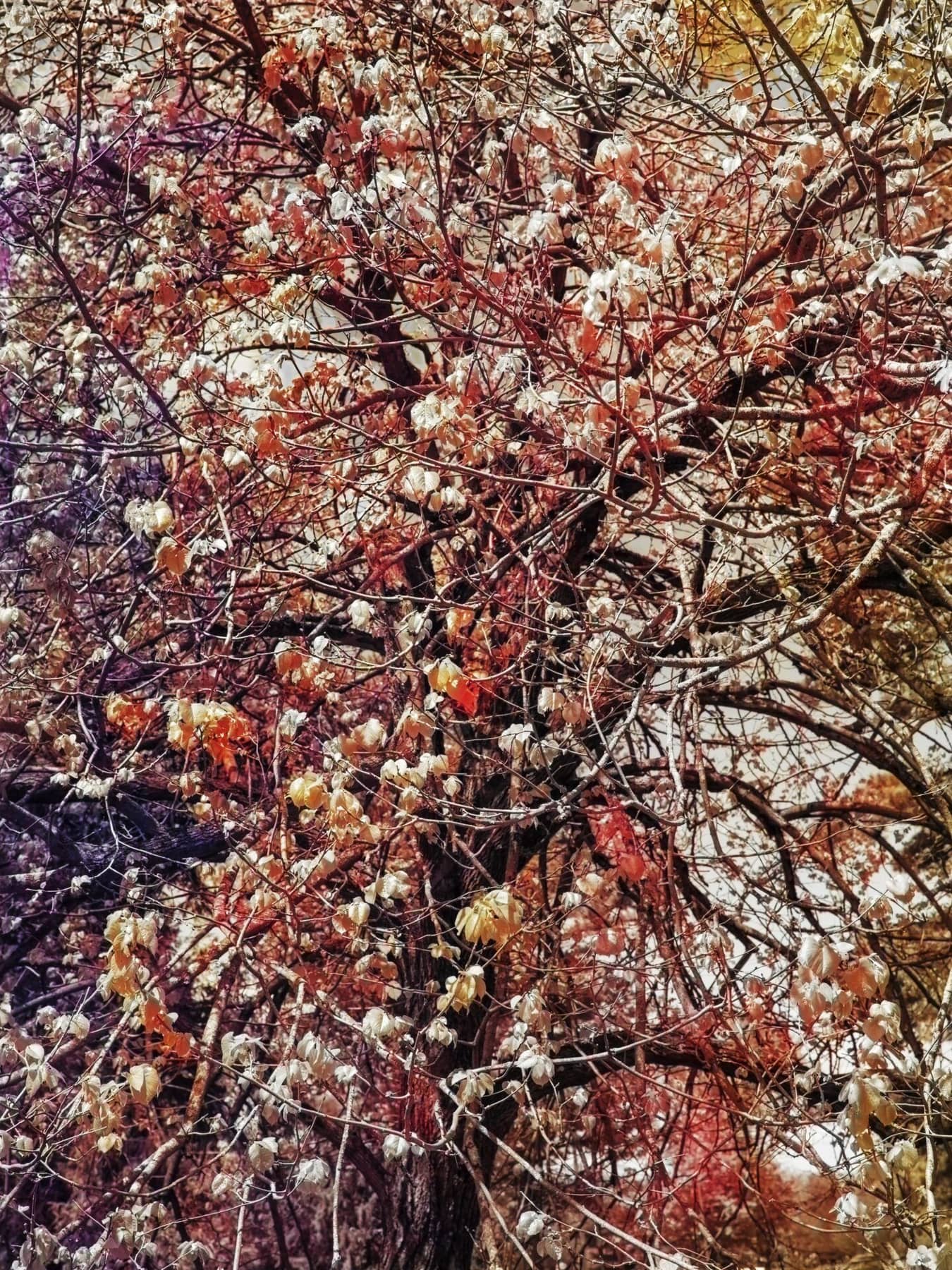
Bloom (#7d5c52), 2020 Dye sublimation on aluminum print 92 × 69 in. Copyright Trevor Paglen Courtesy of the Artist, Jessica Silverman, San Francisco and Pace Gallery.
With Zero 10, I specifically didn’t want to have one thing at the center that everybody was Instagramming. I wanted something that felt more nuanced and exploratory, something that asked more of the audience. I wanted different modulations, without a single focal point that everything revolved around.
Zero 10 was his first time curating an exhibition, and he reflects on whether he would do it again.
It was the first exhibition I’ve ever curated, apart from putting together little shows with friends in graduate school. I’d happily do it again, but curating is a lot of work. I already have a full-time job making art. It’s not just selecting artists. It’s all the emotional labor, the convincing, the problem-solving, and dealing with everyone’s different needs.
He was also responsible for how the works were placed.
It was much more classically curated than a typical art fair. We thought carefully about sightlines and relationships between works. You might see Vera Molnár, Harold Cohen, and William Latham together, and through that sequence you literally see a historical trajectory unfold.
One of the promises of NFTs was that artists would no longer need so-called gatekeepers or curators, and could sell their work directly to collectors online.
Online spaces have, in some ways, taken over the role that basement galleries once had. They’ve made it much easier to share work, and I think that’s great. The downside is that they privilege the kinds of work that are easily shared online, which is only a small fraction of what’s possible in art. I value curation because it’s a form of storytelling. It creates a framework through which audiences encounter artworks. If you place 0xDEAFBEEF next to Rafael Lozano-Hemmer’s and Vera Molnár’s work, you see the 0xDEAFBEEF work differently.